
Right to Repair: The Economic Engine America Needs
How legislative momentum across the pond reveals the untapped potential of America’s repair economy
The United Kingdom Parliament just delivered a message that should resonate in every statehouse across America. In their groundbreaking report “Kickstarting the circular economy: A six step plan to make better use of resources,” the All-Party Parliamentary Group for the Environment didn’t just call for environmental reform—they outlined an economic transformation that positions right to repair as a cornerstone of national resilience.
As Chair Andrew Pakes MP framed it, this isn’t merely about fixing broken devices. It’s about answering fundamental questions facing modern economies: “How do we make the UK more resilient in a fractured world? How do we bring skilled jobs to our high streets and industrial heartlands? How do we clean up our streets, rivers and seas?”
The answers, according to the parliamentary report, lie in making better use of precious resources through repair, reuse, and recycling. For America’s tech repair industry, this international recognition validates what we’ve long understood: right to repair isn’t just good policy—it’s essential economic strategy.
The Economic Case Grows Stronger
The UK report emphasizes three core principles that should guide right to repair implementation: products designed for repairability, increased affordability of repair services, and consumer access to repair information. These aren’t abstract ideals—they represent concrete economic opportunities.
Consider the numbers. The UK currently holds the dubious distinction of having the second-highest level of electronic waste per person globally. The United States isn’t far behind, generating over 6 million tons of e-waste annually while recycling less than 20 percent of discarded electronics. This represents not just environmental catastrophe, but massive economic waste.
The parliamentary report makes a compelling connection between right to repair and cost of living relief. Poorly-made products disproportionately impact low-income households, where cheap goods must be repeatedly replaced rather than repaired. This cycle traps families in perpetual consumption while denying them access to the economic benefits of repair services.
Dame Caroline Dinenage MP captured the broader vision: “The circular economy has the potential to boost regional growth and leave Britain cleaner and greener for our children. Increasing the size of the repair and reuse economy, and promoting these skills at a local level, must be central to reforms.”
America’s Legislative Momentum
Right to Repair Tech
While the UK calls for comprehensive reform, America is already witnessing unprecedented legislative momentum. This year alone, 35 states have introduced right to repair legislation, with five states successfully passing six bills into law. The movement has evolved from advocacy to implementation, creating real economic opportunities for repair businesses nationwide.
Pennsylvania represents the latest breakthrough. House Bill 1512 recently passed the House Commerce Committee by a bipartisan vote of 15-11, demonstrating that right to repair transcends traditional political divisions. The bill now advances to the full state house, where it could join Washington’s landmark legislation as the strongest right to repair law in the nation.
Washington’s law, which takes effect January 1, 2026, bans parts pairing and requires original equipment manufacturers to provide repair resources to independent shops. Microsoft’s support for the legislation, combined with iFixit’s designation as “the strongest law yet,” signals a fundamental shift in how technology companies approach repair policy.
This legislative success builds on victories in Colorado, Oregon, New York, Minnesota, and California, creating a patchwork of repair-friendly jurisdictions that collectively represent massive economic opportunity. Each new law validates the repair industry’s economic importance while creating precedent for federal action.
The Skills Economy Opportunity
The UK report emphasizes investment in skills development as crucial for circular economy success. Their proposal for Skills England to focus on repair, remanufacturing, and recycling careers offers a template for American workforce development.
“Boosting the number of apprenticeships in semi-skilled professions, which do not require a degree or advanced training, will improve the accessibility of circular professions,” the report states. This insight directly addresses America’s skills gap while creating pathways to middle-class careers that can’t be outsourced.
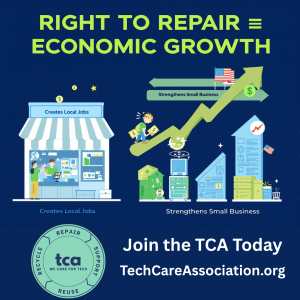
Right to Repair isn’t just about fixing devices—it’s about fixing our economy. Creating skilled jobs that can’t be outsourced, cutting costs for families, and building resilient communities one repair shop at a time. 🔧💼
Tech repair exemplifies this opportunity. The average repair shop employs three to four technicians, providing local jobs that serve local communities. These positions offer competitive wages—with labor rates typically ranging from $60 to $100 per hour—while requiring practical skills rather than expensive degrees.
The repair economy also demonstrates remarkable resilience. During economic downturns, consumers increasingly choose repair over replacement, creating counter-cyclical demand that stabilizes employment. This economic characteristic makes repair businesses valuable community anchors that strengthen local economies during challenging times.
Building Economic Resilience
The UK report’s emphasis on economic resilience resonates particularly strongly in America’s current trade environment. With tariffs on Chinese goods reaching 34-54 percent and lithium-ion battery tariffs at 173 percent, repair services offer crucial alternatives to expensive replacement cycles.
Independent repair shops provide economic buffers against supply chain disruptions and price volatility. When new device prices spike due to trade tensions or component shortages, repair services become increasingly valuable to consumers and businesses alike. This dynamic creates natural market opportunities for repair businesses while reducing economic vulnerability to international trade disputes.
The repair industry’s distributed nature also enhances economic resilience. Unlike manufacturing that can be concentrated in specific regions or countries, repair services must remain local to serve customers effectively. This geographic distribution creates economic stability that benefits communities nationwide.
The Innovation Imperative
Beyond traditional repair services, the industry stands poised for technological innovation that could dramatically expand economic impact. Software platforms designed to connect consumers with local repair services, artificial intelligence tools for diagnostic automation, and blockchain systems for parts authentication represent emerging opportunities.
The UK report acknowledges this innovation potential, calling for partnerships between repair businesses and technology developers. American repair businesses are already pioneering these collaborations, creating competitive advantages that could position the United States as a global leader in repair technology.
Three-dimensional printing offers another frontier for repair innovation. As printing technology advances and material costs decline, repair shops could manufacture replacement parts on-demand, reducing inventory costs while expanding service capabilities. This technological evolution could transform repair from a labor-intensive service to a technology-enabled industry with significantly higher economic impact.
United We Repair: A Call to Action
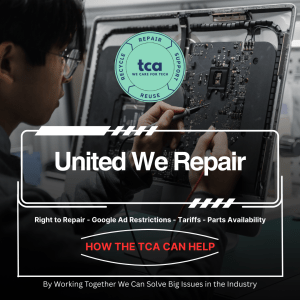
United We Repair Coalition
The convergence of international recognition, domestic legislative momentum, and technological opportunity creates an unprecedented moment for America’s tech repair industry. The UK Parliament’s report validates our economic arguments while Pennsylvania’s legislative progress demonstrates political viability.
This moment demands coordinated action. Individual repair shops, working in isolation, cannot fully capitalize on these opportunities. Industry partners (companies who benefit from a strong repair ecosystem), operating independently, cannot achieve the scale necessary for meaningful policy influence. The challenges we face—from Google advertising restrictions to tariff impacts on parts pricing—require collective solutions.
The TCA: Tech Care Association is launching the United We Repair Coalition on June 13, 2025, to harness this moment for transformative change. Our coalition will unite repair businesses, parts suppliers, software developers, and advocacy organizations around four critical objectives: eliminating Google advertising restrictions, advancing right to repair legislation, securing tariff exemptions for repair parts, and increasing parts availability across the industry.
Success requires participation from across the repair ecosystem. Repair shops investing as little as $10 monthly can help build the coalition strength necessary for policy victories. Industry partners contributing as little as $100 monthly can demonstrate commitment to industry growth while accessing expanded market opportunities.
The UK report concludes with Afzal Khan MP’s challenge: “We need bold and comprehensive leadership to tackle the waste crisis. The government has come in with the right ambition and now needs to support circular business to grow.”
America’s repair industry doesn’t need to wait for government leadership. We can create the bold, comprehensive action necessary to realize our economic potential. The legislative momentum exists. The economic arguments are proven. The technological opportunities are emerging.
What we need now is unity. The United We Repair Coalition represents our industry’s best opportunity to transform individual struggles into collective strength, scattered advocacy into coordinated action, and economic potential into economic reality.
The UK Parliament has shown us the vision. Pennsylvania has shown us the path. Now it’s time to show the world what American innovation and determination can accomplish when we work together.
United we repair. United we prosper. United we win.
The Tech Care Association’s United We Repair Coalition launches July 1, 2025. Join thousands of repair professionals working together to strengthen our industry, create economic opportunity, and build a more sustainable future. Learn more and become a founding member in July 2025.






 TCA: Tech Care Associaiton
Leave a Reply
Want to join the discussion?Feel free to contribute!