Posts

Right to Repair in 2026: Action Guide for Tech Repair Pros | Tech Care Association

Right to Repair in 2026: Action Guide for Tech Repair Professionals

The right to repair isn't just a movement anymore—it's the new reality for tech care professionals. After years of battling for basic access, 2025 marked the leap to Right to Repair 2.0. Now, we're not just talking about getting parts and manuals—we're fighting for real, enforceable protections against things like software locks and parts pairing that quietly threaten our industry's future.

Why 2026 Is a Turning Point

New laws are kicking in. Legislative momentum is building. Manufacturers are watching our every move. States that act in 2026 will set the tone for device design, calibration access, and repair policies across the country. This is the year to get loud, get organized, and make sure tech repair professionals are leading—not following—the conversation.

Related: Digital Right to Repair 2026: The New Rules of the Game for Tech Repair Pros

What's Changed: From Access to Enforcement

States like Oregon and Colorado didn't just talk—they passed laws that explicitly ban parts pairing. The EU's new Right to Repair directive, launching in 2026, weaves repair into both consumer protection and climate action. We're moving from symbolic gestures to rules with teeth.

These shifts represent a fundamental transformation in how we approach independent repair. The question is no longer whether repair should be protected—but how it works, who gets to do it, and who benefits.

See also: Big Tech Decides When Your Stuff Breaks. Right to Repair in 2026 Can Stop Them

Where the U.S. Stands Now

States with real digital right-to-repair laws: New York, Minnesota, California, Oregon, Colorado, Washington, and Texas. More states are on deck for 2026, with legislative sessions starting across the country.

🎯 Virginia and Maryland: Priority Targets

Both states start their legislative sessions on January 14, 2026.

Virginia already has a digital right-to-repair bill on record and strong repair momentum. Maryland lawmakers have demonstrated interest in repair as both consumer protection and climate policy. These are critical battlegrounds where tech repair professionals can make an immediate impact.

Action Plan: What Tech Repair Pros Should Do Now

  • Get organized locally. Build relationships with your legislators before sessions start. Don't wait for a crisis—be the expert they trust.
  • Document your pain points. Collect stories, photos, and invoices showing how parts pairing, software locks, and manufacturer restrictions impact your business and customers. Real-world evidence is gold.
  • Prepare to testify. Your voice matters. Use clear, specific examples of how these barriers cost you time, revenue, and reputation. Lawmakers need to hear from YOU, not just lobbyists.
  • Team up. Align with consumer, environmental, and workforce groups. We're stronger together, and united voices get noticed.
  • Educate your customers. Be transparent about what's blocking repairs and how policy can fix it. Use your storefront, social media, and receipts to share the message.

Further reading: Digital Right to Repair: Why You Deserve Control Over Your Devices

🔍 Find Your State Representatives

Building relationships with your state lawmakers is a game-changer for your shop and the right to repair movement. Use these trusted resources to find your legislators and their contact information.

Official Legislator Lookup Tools:

🔗 Common Cause: Find Your Legislators

Simple address lookup for state and federal representatives

🔗 Open States: Find Your Legislator

Comprehensive state legislative information and contact details

🔗 USA.gov: Elected Officials Directory

Official government directory for all elected representatives

💡 Pro Tip: You can also search "[your state] find my legislator" to access your state's official legislative website, which will have the most current contact information.

Connect with Your State Representatives

Sample Message to Request a Meeting

Email Template:

Subject: Request for Meeting: Local Tech Repair Shop & Right to Repair

Hi [Representative Name],

My name is [Your Name], and I own [Your Shop Name] in [Your Town]. As a local small business owner, I'm reaching out to discuss the impact of right to repair legislation on our community and local economy.

I'd appreciate the opportunity to meet with you (in person or virtually) to share how recent and upcoming laws affect both our business and our customers. I can provide real-world examples and answer any questions you may have about the tech repair industry in [Your District].

Please let me know your availability in the coming weeks. Thank you for your time and for representing our community!

Best regards,
[Your Name]
[Your Shop Name]
[Contact Info]

💡 Outreach Tips:

  • Be concise, respectful, and direct
  • Mention you're a constituent and local business owner
  • Offer specific dates/times if possible
  • Follow up if you don't get a response within a week

Get the Word Out: Contacting Local Media

Don't underestimate the power of local media to amplify your story and put the spotlight on the challenges—and importance—of independent repair. Media coverage not only boosts your shop's visibility but also helps educate the community and pressure policymakers to act.

Who to Contact:

  • Local newspapers (editors, business reporters, community desk)
  • TV news stations (assignment editors, consumer reporters)
  • Radio stations (morning show hosts, news directors)
  • Community blogs or online news outlets
  • Local business journals

Sample Email to Local Media

Email Template:

Subject: Local Tech Repair Shop Champions Right to Repair in 2026

Hi [Name],

I'm [Your Name], owner of [Your Shop Name] here in [Your Town]. As a local tech repair professional, I'm on the front lines of the right to repair movement—a cause that's gaining real momentum in 2026 with new laws and growing community support.

Our shop has seen firsthand how software locks, parts pairing, and manufacturer restrictions impact local families, small businesses, and the environment. I'd love to share our story and help your audience understand why protecting the right to repair matters for everyone in [Your Town].

Would you be interested in covering how these changes affect our community, or speaking with me for a local perspective? I can provide real-world examples and connect you with customers who've been impacted.

Thanks for your time—looking forward to connecting!

Best,
[Your Name]
[Your Shop Name]
[Contact Info]

💡 Pro Tips:

  • Personalize your email—mention a recent story they ran or why their audience will care
  • Include a photo of your shop/team if possible
  • Offer to demonstrate a repair or show how policy changes impact real customers

What Success Looks Like in 2026

📜

More State Right to Repair Laws

Laws tackling software locks and anti-repair tactics

⚖️

Clearer Manufacturer Rules

Enforceable expectations for device makers

🔓

Fewer Repair Barriers

Reduced warning pop-ups and feature lockouts

💪

Industry Confidence

Investment in new skills, tools, and staff

🤝

United Tech Repair

A respected, organized industry coalition

TCA's Take: Repair Is Infrastructure—And So Are You

Repair keeps devices working, money in local economies, and e-waste out of landfills. In 2026, we're not asking if repair should be protected—we're deciding how it works, who gets to do it, and who benefits. That means showing up, speaking out, and supporting each other.

Every Voice Counts

Every shop, every tech, every customer story counts. The future of repair is being written right now—by people who care enough to act. Let's make sure it's our story that gets told.

Ready to Take Action?

Join the movement and make your voice heard in 2026

Join TCA's Advocacy Network Share Your Story Subscribe for Updates

Repair first. Repair local. Repair together.

Have feedback or a story to share? Drop us a line or join the conversation on LinkedIn or Facebook.

Digital Right to Repair 2026: New Rules for Tech Repair Pros

Digital Right to Repair 2025–2026: The New Rules of the Game for Tech Repair Pros

The rules of the tech repair industry are changing fast—and for once, they're starting to change in favor of the people who actually keep devices running: you.

Colorado's New Law: A Glimpse of the Future

Starting January 1, 2026, Colorado will set a new standard for digital right to repair. The state's new Right to Repair Digital Electronic Equipment law requires manufacturers to provide independent repair shops and consumers with the tools, parts, and documentation needed to fix smartphones, computers, smart appliances, and more.

This law doesn't just open up access—it also prohibits parts pairing to block independent repairs, bans false warnings about non-OEM parts, and requires transparency from shops about parts sourcing. It's the third major right to repair win in Colorado in three years, following laws for powered wheelchairs and agricultural equipment.

"The more competition you have, the more likely it is that you're going to save money. If there's only one choice, that entity can charge you more." — Danny Katz, CoPIRG (Colorado Public Interest Research Group)

A Wave of State Action

Colorado isn't alone. States like New York, Minnesota, California, Oregon, Washington, and Texas have enacted digital right to repair laws. Many more—including Virginia, Maryland, Illinois, Massachusetts, Michigan, New Jersey, Pennsylvania, New Mexico, Wisconsin, Florida, Tennessee, Missouri, and New Hampshire—have active or pending bills for 2025–2026 (Repair Association updates).

These laws share a few key goals:

  • Require manufacturers to provide parts, tools, and manuals
  • Prevent software and digital locks from blocking fair repair
  • Open up competition for repairs and parts

What This Means for Your Shop

For repair professionals, these changes are both a challenge and an opportunity:

  • Access: More devices will be legally repairable, with fewer barriers to parts and diagnostics.
  • Transparency: You'll need to clearly inform customers if you're using non-OEM or used parts.
  • Accountability: The law prohibits misleading warnings about non-OEM parts and bans performance throttling after independent repairs.

Shops that stay ahead of these rules will be able to:

  • Offer faster, more affordable repairs
  • Build trust with customers through transparency
  • Position themselves as local leaders in digital right to repair

Market Narrative: Why Big Tech Wants You to Upgrade

A recent CNBC story framed Americans holding onto devices longer as a problem for the economy. But the real problem is the power Big Tech wields to make it difficult, expensive, or even impossible to keep tech running.

Through software locks, parts pairing, and restricted repair info, manufacturers push for upgrades and limit your choices. Right to repair is about making it possible, affordable, and normal to keep devices as long as you want.

When the market narrative says "upgrading is good for business," it's time for repair pros to push back and show that longevity, not forced obsolescence, is the future.

How to Get Involved: Make Your Voice Heard Before the Legislative Season

Legislative sessions start in January in most states—it sneaks up fast after the holidays! Now is the time to organize and take action. Here's how you can make a difference:

Action Steps for Repair Professionals

  • Find your state legislators: Use this directory to identify your representatives: State Legislature Websites
  • Contact them now: Send a short, direct message or email explaining why right to repair matters to you and your business. Tell your story—real-world examples carry weight.
  • Take it a step further: Schedule a meeting with your legislator. Remember: THEY WORK FOR YOU. Legislators are often more receptive than you might think, especially when you're polite, prepared, and specific.
  • Organize locally: Connect with other repair professionals in your state. A united voice is far more powerful—consider forming or joining a local coalition.
  • Share your stories: Lawmakers need to hear from real repair pros about what works—and what still needs fixing. Your experience matters.
  • Follow and support advocacy organizations: Groups like United We Repair and Repair.org are leading the way. Donating to Repair.org is worthwhile—they're a key player in the national movement, though they don't often work with groups outside their established network.

What You Can Do Now

  • Get familiar with your state's laws and what's coming next.
  • Educate your customers. Explain new rights, anti-parts-pairing protections, and why transparency matters.
  • Join coalitions like United We Repair. The more we work together, the more we can accomplish.

The Bottom Line

Digital right to repair is rewriting the rules. Shops that embrace change, educate their customers, and lead on transparency will not just survive—they'll thrive.

The next era of tech repair belongs to the professionals who fight for the right to keep devices running, not just for today, but for as long as people choose to own them.

Stay tuned for more in this series as we break down the details, answer your questions, and help you prepare for what's next.

Sample Email Templates for State Legislators

Template 1: Stressing the Need for Right to Repair

Template 2: Requesting a Meeting to Discuss Right to Repair

What if I told you there’s a simple switch that could double or triple your business overnight – but Google won’t let you flip it?
Hey repair pros,
Rob here with some news that might shock you. There’s a massive barrier standing between you and exponentially more customers, and most shop owners don’t even realize it exists.

The Hidden Ban That’s Costing You Thousands

Since October 2018, Google has completely banned ALL third-party tech repair businesses from advertising on their platform. That means:
  • ❌ No Google Search ads
  • ❌ No Display Network ads
  • ❌ No YouTube advertising
  • ❌ No Gmail promotions
  • ❌ No Google Shopping ads
Think about that for a second. When someone in your town searches “phone repair near me” or “laptop screen fix,” Google won’t let you show up in the paid results – no matter how much you’re willing to spend.

What This Actually Means for YOUR Shop

Let’s get real about what you’re missing:
The Average Repair Shop Could Generate:
  • $28,400 per year in Google Ads
  • Which typically returns $113,600 in revenue (that’s a 4:1 return!)
  • That’s potentially $9,466 MORE per month in your pocket
But here’s the kicker: Apple, Samsung, and Best Buy? They can still advertise their repair services all day long. Only independent shops like yours are banned.

A Real Shop Owner’s Nightmare

“On 4/21/25 our Google Ads account for Fruit Fixed was permanently suspended for no explicit reason. We did nothing wrong — Google has simply lumped laptop and cellphone repair under a banned category of ‘third party tech support’… Other industries that are banned: firearms, adult content, gambling, pay day loans — and tech repair? It doesn’t make sense, because it doesn’t make sense.”
Justin spent a month jumping through hoops for Google’s new “Local Service Ads” program, got background checks, bought special insurance – only to have Google reject his ads within 24 hours for the same bogus “third party tech support” violation.
This is happening to thousands of shops right now.

Why Most Shops Don’t Know About This

Here’s the thing – if you’ve never tried Google Ads, you might not realize what you’re missing. It’s like being banned from the biggest mall in America but never knowing the mall existed.
But imagine if you could:
  • Turn on ads whenever you’re slow
  • Scale up during busy seasons
  • Target customers searching for exactly what you fix
  • Compete on equal footing with the big guys


Others Have Tried and Failed

For years, other organizations (US PIRG, iFixit, CTIA/WISE, Independent Shops) have talked about fixing this issue. They’ve written blog posts, made noise on social media, even started petitions. But guess what? Nothing has changed. Google’s ban is still in full effect, and shops are still getting suspended every day.
The difference? They talked. We’re going to act.

TCA Is Going to Win This Fight

The Tech Care Association isn’t just another organization making empty promises. With your help, we’re going to take on Google and WIN. Here’s why we’re different:
We have the research – Our soon to be released new white paper documents exactly how this ban has cost the industry $5 billion annually — we are currently working a national news rollout
We have the legal framework – We’re exploring antitrust violations and anti-competitive practices
We have the industry backing – Thousands of shops ready to fight together – JOIN US
We have the determination – This isn’t a side project for us. This IS our mission.

The Industry’s Biggest Hurdle

Forget parts costs. Forget manufacturer restrictions. Forget training issues.
This Google ban is the single biggest obstacle holding back our entire industry.
Think about it: What’s the point of fighting for right-to-repair if customers can’t even find you to get their devices repaired?

What This Victory Means for You

When we win this fight (and we will), you’ll be able to:
  • Flip the switch on Google Ads whenever you want more customers
  • Scale rapidly by increasing ad spend during growth phases
  • Compete fairly against manufacturers and big box stores
  • Reach customers actively searching for repair services
  • Control your growth instead of hoping for walk-ins

Join the Fight

This isn’t just about advertising. This is about fairness. This is about your right to compete. This is about building the business you deserve.
The repair industry has been silent too long. It’s time to roar.
Ready to help us take down this $5 billion barrier? Here’s how:
  1. Share your story – Have you been affected by Google’s ban? Tell us.
  2. Spread the word – Forward this to every repair shop owner you know
  3. Support the causeJoin the TCA or Upgrade your TCA membership to fund this fight
  4. Stay tuned – We’ll be announcing specific action steps soon
The days of Google treating legitimate repair businesses like scammers are numbered. With your help, we’re going to restore fair competition and unlock the growth potential that’s been stolen from our industry.
Together, we’re going to win.

Rob Link
Founder & CEO, Tech Care Association
P.S. – Want to read the full research? Download our complete white paper “The Google Ads Ban: A $5 Billion Crisis for America’s Tech Repair Industry”. The data will blow your mind. Available in July 2025!

Every day, you face the same frustrating questions: Why can’t I advertise my business effectively? Why are parts so expensive and hard to find? Why do manufacturers like Apple and Samsung seem to work against me and my business? Why does it feel like the deck is stacked against independent repair shops?

Here’s why you should care: These aren’t just inconveniences—they’re systematic barriers designed to squeeze out independent repair businesses and funnel customers toward expensive manufacturer programs and new device sales.

But what if I told you there’s a proven way to tear down these barriers? That thousands of repair shops working together can force real change? That’s exactly what the United We Repair Coalition is designed to do.

Why Should You Care?

Because These Problems Are Costing You Serious Money

Google Ad Restrictions: Your Customers Can’t Find You

Why You Should Care: 73% of consumers search “phone repair near me” on Google first, but Google’s 2018 advertising ban means your shop is invisible while “authorized centers” and new device ads dominate search results.

What’s At Stake: Access to Google Ads could increase your monthly revenue by 25-40%. If you’re making $15,000/month, that’s $3,750-$6,000 you’re leaving on the table every single month.

Industry Impact: This advertising lockout costs independent repair shops at least $3.4 billion annually based on our comprehensive industry analysis—money that should be flowing to businesses like yours.

Right to Repair: You’re Locked Out of Profitable Services

Why You Should Care: Manufacturers deliberately restrict access to parts, tools, and repair manuals, forcing 60% of potential repairs toward their expensive programs or new device sales.

What’s At Stake: Washington State’s new right-to-repair law (effective 2026) will give shops access to previously forbidden iPhone and Samsung repairs. Early projections suggest this could double repair volume for participating businesses.

The Big Picture: Right to repair could unlock $50 billion in repair revenue nationwide—but only if we fight for comprehensive legislation everywhere, not just piecemeal state victories.

Tariff Threats: Parts Prices Could Explode 145% or More

Why You Should Care: The administration’s 90-day tariff pause expires August 14th. Without repair industry exemptions, parts costs could skyrocket, making repairs uncompetitive against new device purchases.

What’s At Stake: Your profit margins and customer retention. When repair costs approach new device prices, customers stop repairing—and you lose business permanently.

The Opportunity: The administration wants to support small businesses while encouraging domestic manufacturing. Repair industry tariff exemptions align perfectly with both goals, but we need collective voice to secure them.

Parts Availability: The $20 Billion Supply Chain Stranglehold

Why You Should Care: OEMs control 80% of parts distribution, creating artificial scarcity that forces you to turn away 35% of potential customers due to parts unavailability.

What’s At Stake: Every customer you turn away represents lost revenue and damaged reputation. Limited parts sources also inflate costs by 20-40% compared to competitive markets.

Our Integrated Approach: The TCA will work with existing parts providers to integrate new supply programs, including forcing OEM programs to open up, partnering with emerging manufacturers, establishing industry-wide parts standards, supporting platforms like the Basile Network for used parts, and collaborating with 3D printing companies. We’re not replacing your current suppliers—we’re expanding your options.

Why Should You Give?

Because Individual Action Gets Individual Results

The Hard Truth About Going It Alone

You can’t negotiate with Google as one shop. You can’t influence tariff policy as one business. You can’t force Apple to open their parts program as one repair service. Individual companies lack the scale and resources to create meaningful change.

The Power of Collective Action

Proven Model: The Auto Care Association represents 3,000+ automotive repair businesses and regularly wins policy battles that benefit the entire industry. They succeed because they speak with one unified voice backed by substantial resources.

Our Target: To start with, our goal is to find 1,300+ repair businesses and 100+ industry partners, growing to thousands of repair businesses and hundreds of industry partners—companies that sell into our industry—creating the largest advocacy force in tech repair history.

Why Your Investment Matters:

  • For Repair Business Owners: We’re only asking you to invest what you can afford—starting at $10/month. If you can afford to give more, additional support levels are available.

  • For Industry Partners: We’re asking parts, software, accessory, tool, and marketing providers and other repair adjacent companies to invest $100/month (or more if they can afford it) because they have greater capacity and benefit from industry-wide growth.

  • Tax deductible as a business expense through our 501(c)(6) structure

  • Immediate ROI: Even small wins on any single issue could generate thousands in additional annual revenue

What Your Investment Buys

We know you’re busy running your business—that’s exactly why the TCA exists. Your membership dollars go toward organizing comprehensive campaigns, executing strategic plans, and hiring full-time professionals dedicated to solving these problems so you can focus on what you do best: running your repair business.

Professional Advocacy Team: Full-time staff conducting executive-level lobbying with Google, Apple, Samsung, and other manufacturers who currently ignore individual shop concerns. We’ll also bring in consultants and attorneys as needed to strengthen our efforts.

Strategic Campaign Execution: Coordinated policy influence in Washington DC, state legislatures, and regulatory proceedings where your business interests are decided.

Industry Leadership: A unified voice that commands respect from policymakers who currently address repair concerns on a fragmented, case-by-case basis.

Transparent Operations: As a 501(c)(6) non-profit, the TCA maintains full transparency in all activities. Members receive regular updates on campaign progress, fund utilization, and strategic developments affecting the industry.

The Bottom Line:

This Is Your Fight, Whether You Join It or Not

These four barriers will continue costing you money every single day whether you participate in the solution or not. The only question is whether you’ll help tear them down or watch from the sidelines while others determine your industry’s future.

The United We Repair Coalition launches July 7, 2025. Over the next month, we’ll be working hard to find the right people, finalize our comprehensive strategy, and prepare for launch. Following the July 7th launch, we’ll spend July and August building our membership, finalizing a board of advisors from a list of respected industry leaders, and holding our first in-person meeting at the All Wireless & Prepaid Expo in August. We’re also open to working with any other organization that will fully endorse our goals and work with us on this important project. Full program implementation begins in September 2025. This isn’t just another trade association—it’s the most comprehensive advocacy effort in repair industry history, backed by the established Tech Care Association and built on a proven model of collective action.

Your business faces systematic challenges that require systematic solutions. Individual action gets individual results. United action gets industry transformation.

The choice is yours: Continue fighting these battles alone with limited success, or join thousands of repair businesses in the largest advocacy effort our industry has ever seen.

United we repair. Divided we struggle.


Ready to stop losing money to systematic barriers? Contact the Tech Care Association in Washington, DC. Coalition membership drive begins with our 60-day campaign launching July 7th, with program implementation starting September 2025.

Right to Repair: The Economic Engine America Needs

How legislative momentum across the pond reveals the untapped potential of America’s repair economy
The United Kingdom Parliament just delivered a message that should resonate in every statehouse across America. In their groundbreaking report “Kickstarting the circular economy: A six step plan to make better use of resources,” the All-Party Parliamentary Group for the Environment didn’t just call for environmental reform—they outlined an economic transformation that positions right to repair as a cornerstone of national resilience.
As Chair Andrew Pakes MP framed it, this isn’t merely about fixing broken devices. It’s about answering fundamental questions facing modern economies: “How do we make the UK more resilient in a fractured world? How do we bring skilled jobs to our high streets and industrial heartlands? How do we clean up our streets, rivers and seas?”
The answers, according to the parliamentary report, lie in making better use of precious resources through repair, reuse, and recycling. For America’s tech repair industry, this international recognition validates what we’ve long understood: right to repair isn’t just good policy—it’s essential economic strategy.

The Economic Case Grows Stronger

The UK report emphasizes three core principles that should guide right to repair implementation: products designed for repairability, increased affordability of repair services, and consumer access to repair information. These aren’t abstract ideals—they represent concrete economic opportunities.
Consider the numbers. The UK currently holds the dubious distinction of having the second-highest level of electronic waste per person globally. The United States isn’t far behind, generating over 6 million tons of e-waste annually while recycling less than 20 percent of discarded electronics. This represents not just environmental catastrophe, but massive economic waste.
The parliamentary report makes a compelling connection between right to repair and cost of living relief. Poorly-made products disproportionately impact low-income households, where cheap goods must be repeatedly replaced rather than repaired. This cycle traps families in perpetual consumption while denying them access to the economic benefits of repair services.
Dame Caroline Dinenage MP captured the broader vision: “The circular economy has the potential to boost regional growth and leave Britain cleaner and greener for our children. Increasing the size of the repair and reuse economy, and promoting these skills at a local level, must be central to reforms.”

America’s Legislative Momentum

Right to Repair Tech

Right to Repair Tech

While the UK calls for comprehensive reform, America is already witnessing unprecedented legislative momentum. This year alone, 35 states have introduced right to repair legislation, with five states successfully passing six bills into law. The movement has evolved from advocacy to implementation, creating real economic opportunities for repair businesses nationwide.
Pennsylvania represents the latest breakthrough. House Bill 1512 recently passed the House Commerce Committee by a bipartisan vote of 15-11, demonstrating that right to repair transcends traditional political divisions. The bill now advances to the full state house, where it could join Washington’s landmark legislation as the strongest right to repair law in the nation.
Washington’s law, which takes effect January 1, 2026, bans parts pairing and requires original equipment manufacturers to provide repair resources to independent shops. Microsoft’s support for the legislation, combined with iFixit’s designation as “the strongest law yet,” signals a fundamental shift in how technology companies approach repair policy.
This legislative success builds on victories in Colorado, Oregon, New York, Minnesota, and California, creating a patchwork of repair-friendly jurisdictions that collectively represent massive economic opportunity. Each new law validates the repair industry’s economic importance while creating precedent for federal action.

The Skills Economy Opportunity

The UK report emphasizes investment in skills development as crucial for circular economy success. Their proposal for Skills England to focus on repair, remanufacturing, and recycling careers offers a template for American workforce development.
“Boosting the number of apprenticeships in semi-skilled professions, which do not require a degree or advanced training, will improve the accessibility of circular professions,” the report states. This insight directly addresses America’s skills gap while creating pathways to middle-class careers that can’t be outsourced.
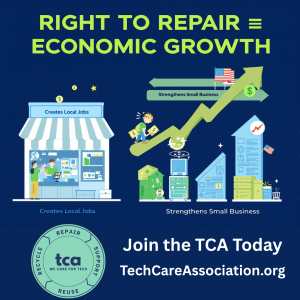
Infographic showing 'Right to Repair = Economic Growth' with visual elements including a repair shop storefront, technician working on electronics, upward trending graphs, and job creation icons, emphasizing how right to repair legislation creates local jobs and strengthens small businesses.

Right to Repair isn’t just about fixing devices—it’s about fixing our economy. Creating skilled jobs that can’t be outsourced, cutting costs for families, and building resilient communities one repair shop at a time. 🔧💼

Tech repair exemplifies this opportunity. The average repair shop employs three to four technicians, providing local jobs that serve local communities. These positions offer competitive wages—with labor rates typically ranging from $60 to $100 per hour—while requiring practical skills rather than expensive degrees.
The repair economy also demonstrates remarkable resilience. During economic downturns, consumers increasingly choose repair over replacement, creating counter-cyclical demand that stabilizes employment. This economic characteristic makes repair businesses valuable community anchors that strengthen local economies during challenging times.

Building Economic Resilience

The UK report’s emphasis on economic resilience resonates particularly strongly in America’s current trade environment. With tariffs on Chinese goods reaching 34-54 percent and lithium-ion battery tariffs at 173 percent, repair services offer crucial alternatives to expensive replacement cycles.
Independent repair shops provide economic buffers against supply chain disruptions and price volatility. When new device prices spike due to trade tensions or component shortages, repair services become increasingly valuable to consumers and businesses alike. This dynamic creates natural market opportunities for repair businesses while reducing economic vulnerability to international trade disputes.
The repair industry’s distributed nature also enhances economic resilience. Unlike manufacturing that can be concentrated in specific regions or countries, repair services must remain local to serve customers effectively. This geographic distribution creates economic stability that benefits communities nationwide.

The Innovation Imperative

Beyond traditional repair services, the industry stands poised for technological innovation that could dramatically expand economic impact. Software platforms designed to connect consumers with local repair services, artificial intelligence tools for diagnostic automation, and blockchain systems for parts authentication represent emerging opportunities.
The UK report acknowledges this innovation potential, calling for partnerships between repair businesses and technology developers. American repair businesses are already pioneering these collaborations, creating competitive advantages that could position the United States as a global leader in repair technology.
Three-dimensional printing offers another frontier for repair innovation. As printing technology advances and material costs decline, repair shops could manufacture replacement parts on-demand, reducing inventory costs while expanding service capabilities. This technological evolution could transform repair from a labor-intensive service to a technology-enabled industry with significantly higher economic impact.

United We Repair: A Call to Action

UNITED WE REPAIR: Tackling the Tech Care Industry's Biggest Challenges

United We Repair Coalition

The convergence of international recognition, domestic legislative momentum, and technological opportunity creates an unprecedented moment for America’s tech repair industry. The UK Parliament’s report validates our economic arguments while Pennsylvania’s legislative progress demonstrates political viability.
This moment demands coordinated action. Individual repair shops, working in isolation, cannot fully capitalize on these opportunities. Industry partners (companies who benefit from a strong repair ecosystem), operating independently, cannot achieve the scale necessary for meaningful policy influence. The challenges we face—from Google advertising restrictions to tariff impacts on parts pricing—require collective solutions.
The TCA: Tech Care Association is launching the United We Repair Coalition on June 13, 2025, to harness this moment for transformative change. Our coalition will unite repair businesses, parts suppliers, software developers, and advocacy organizations around four critical objectives: eliminating Google advertising restrictions, advancing right to repair legislation, securing tariff exemptions for repair parts, and increasing parts availability across the industry.
Success requires participation from across the repair ecosystem. Repair shops investing as little as $10 monthly can help build the coalition strength necessary for policy victories. Industry partners contributing as little as $100 monthly can demonstrate commitment to industry growth while accessing expanded market opportunities.
The UK report concludes with Afzal Khan MP’s challenge: “We need bold and comprehensive leadership to tackle the waste crisis. The government has come in with the right ambition and now needs to support circular business to grow.”
America’s repair industry doesn’t need to wait for government leadership. We can create the bold, comprehensive action necessary to realize our economic potential. The legislative momentum exists. The economic arguments are proven. The technological opportunities are emerging.
What we need now is unity. The United We Repair Coalition represents our industry’s best opportunity to transform individual struggles into collective strength, scattered advocacy into coordinated action, and economic potential into economic reality.
The UK Parliament has shown us the vision. Pennsylvania has shown us the path. Now it’s time to show the world what American innovation and determination can accomplish when we work together.
United we repair. United we prosper. United we win.

The Tech Care Association’s United We Repair Coalition launches July 1, 2025. Join thousands of repair professionals working together to strengthen our industry, create economic opportunity, and build a more sustainable future. Learn more and become a founding member in July 2025.

Stop juggling complicated pricing formulas for your repair shop. The secret to profitable, transparent pricing isn’t in complex calculations or random discounts – it’s in this simple formula: Parts (with markup) + Labor (hourly rate × time) = Final Price. We’ve analyzed hundreds of TCA member experiences to bring you this streamlined approach that’s revolutionizing how successful repair shops price their services. Whether you’re struggling with multi-component repairs or looking to boost your bottom line, this proven system will transform how you price repairs…

The tech repair industry is so much more than phones but that seems to be almost everyone’s focus. Fix more phones. Sell more phones. Get Apple & Samsung to give us better access to more phone repairs. Make Google easier to market our phone repair business to more people. Phones. Phones. Phones

Phones are the bright shiny object that every repair shop lusts over. Cracked screens are the low hanging fruit (pun intended) that gets everyone into this business.

So much so that Allstate Protection Plans recent Mobile Mythconceptions Survey declared it an $8.3billion market. Just for CRACKED SCREENS, the overall market is much bigger

But what if I told you that there is a better way?

The inspiration came to me over a year ago during a call with a major OEM (I mean a big one that sells a lot of phones). We were speaking to an influential contact that offered to help get us to the right person to get more repair work. He said to us, “have you ever considered small appliances. Because EVERYONE tries to get the phone business.”

Of course. Every repair related company in the world wants the phone business! And it’s nothing but a race to the bottom to offer the lowest prices. Whether you’re a repair shop fighting against 20 other shops in your area or a wholesaler trying to compete. Everyone wants the lowest price, which makes it tough to make any money at all.

Friends, the consumer electronics (CE) industry is a trillion dollar industry, and yes phones make up about half of it. So of course everyone’s attention is focused on phones. But think about it this way. If half of the CE industry can create a $40 billion phone repair industry (my estimate) what can the other half create?

You’ve heard me say it many times in the past. More and more products are becoming tech. That’s on display every year at CES. Workout equipment. Kitchens (pots & pans, cutting boards, small appliances, etc.), vacuums, pet products, and so much more! All of it needs to be repaired and serviced. Right now too much of it gets destroyed because it has to be shipped for service/repair.

This creates e-waste — which has become a global nightmare. If companies can get their products serviced easier, without shipping it, it’s more likely to stay in the market.

The consumer electronics industry is diversifying!

I wrote a very short piece back in July last year that got a ton of responses. A lot of repair people wanted to know how to diversify their business. I even noticed a few other people in the industry claim they had the answers. It’s an important question. Beyond that it is also an incredible opportunity.

An opportunity that one person or one company will never fully capitalize on. But one that a collaboration of companies will be able to seize. This is what I mean when I encourage the industry to work together — which some, unfortunately, never will. But that’s okay. They will just simply get left behind cleaning up the shards of glass in their shops.

Independent tech repair has all of the advantages to be able to service more diverse products. But no bigger advantage than it’s network of locations across the country (some estimate more than 25K locations). These are what I like to call community based tech care locations.

Two important points here on naming: 1) the word TECH is more ubiquitous (it covers more than phones), and 2) the word CARE includes repair but covers so much more. More means troubleshooting, support, diagnostics, setup, etc. We are the tech care industry, and tech repair is one of the biggest segments for us. AND we can be more!

Working Together – Staying In Our Lanes

We can ALL succeed if we ALL stay in our own lanes and appreciate what others do. It’s important too to have an attitude of win/win when working with partners. In other words, I win if you win. Meaning sometimes you have to give up something for someone else to win too.

For local TECH REPAIR BUSINESSES that means focusing on what you do best: Repairing tech. Advance your skills, stay focused on repair, and taking great care of customers. You are the frontline!

For ADVANCED TECH REPAIR that means opportunities to support more devices and create more solutions. Find ways to help OEMs fix their products that can scale. Fix things and post videos that help everyone learn how to do the work.

For national WHOLESALE/DISTRIBUTORS you play an important role here. Be ready to manage different parts and support more products. You are the lifeline for those in the tech repair business.

For REPAIR DEPOTS realize that your solution is a legacy one and not what customers want as a first option. There is still a lot of demand that can and will flow into your channel from the frontline.

For REFURBISHERS & RECYCLERS help design systems to pickup products from the frontline. Either using a regional hub model or a simple pickup and delivery system. Lots of opportunity for the companies that get it right.

Some of you just simply need to stay out the way. You don’t need to be a part of everything or pretend you know what you’re doing. It’s best if you ask yourself and others how can I help.

The strength here is THE NETWORK! It is all of the different segments of the industry working together to help lift up the industry. It is having a win/win attitude that is more focused on the greater good than selfish deeds.

For the TCA it means we are the glue that brings everyone together. Join us (literally become a member) and let’s all work together to make the tech care industry into what it can be!

Want More Repair Business? Say Yes!

As a guy who ran a multi-shop tech repair business and did a lot of consulting work I know the true secret to success. SAY YES MORE OFTEN! Okay, it’s not really a secret it’s really just a good business practice. Successful companies, in any industry, find a way to say yes to their customers more often.

How many times does a customer call or come into your business and ask, “Can you fix…?” And how many times do you and your staff not say yes immediately or even worse you say no? I promise if your honest with yourself you will realize how often this happens or how often your staff says no.

Listen I saw it all the time in my repair business and I had three shops that grossed over $1million in revenue. It would drive me crazy! My most successful shops were confident and said yes. My least successful shops doubted and said no.

Friends, you operate a REPAIR BUSINESS. Every time some one asks if you can fix something you say YES — without blinking — without hesitating — without doubting. And don’t you dare ever say NO.

This philosophy should exist in all circumstances!

Why Say Yes, Every Single Time?

Because it’s true. Everything can be fixed. The only variable is how much is the customer willing to pay to fix it. That’s not your job to decide — let me say that again. It is NOT your job to decide if a customer should fix something or not. Your job is to fix things. Determine a price. Deliver the price to the customer. Always be honest and let them decide.

You have to have the attitude that everything can be fixed (for a price) if you want to succeed in this business. You have to establish this as your mantra and drill it into your employees. Otherwise you’re going to say no, or maybe, and then you’ll lose more business than you win.

Find partnerships that can help you succeed in the short term and then learn the skills you need to bring all of the business in-house.

Now I’ve been at this for 20 years and my shops repaired tens of thousands of devices. Could we fix everything that came into our shops? NO, of course not. But that’s not what’s important here. It’s the attitude you have to have to win. People who win have a winning attitude. I could list dozens of examples (sports, business, arts, etc.), but I think you know what I mean. But seriously, do you think a guy like Elon Musk ever doubts what he can do??!! In repair that means saying yes to your customers with all of the confidence you have.

If you want to win you have to have a winning attitude!

How Do You Back It Up?

First of all, you are going to surprise yourself. You are going to challenge your staff or yourself to fix something unfixable and you’re going to win.

Maybe it’s a repair above you or your companies capabilities — keep learning! In that case you can ship it off to another shop. In my early days we couldn’t micro-solder so we shipped all of those jobs off to another shop for repair. We didn’t make a lot on those transactions but we got a reputation in the market that we could fix anything. Once we learned how to micro-solder the profit followed.

You get one shot to win a customer — they aren’t going to check back with you in the future to see if you can do new things. Say yes and then figure it out! When you do you will win more business, they come back, and they will refer you to others.

NEVER SAY NO! Offer the customer a solution even if it doesn’t make sense to you. Super old phone? Might make sense to you to upgrade. But what if they have a special rate plan that they would lose if they switched devices??? I’ve also seen people that have a sentimental connection to a device. Doesn’t make practical sense but it’s what they want. JUST SAY YES!

In the startup world there is an expression called “Fake it till you make it” — I’m sure you’ve heard it. Here’s a good definition: to consciously cultivate an attitude, feeling, or perception of competence that you don’t currently have by pretending you do until it becomes true.

Sometimes you have to fake it till you make it!

“I Only Want To Fix __________ !”

When uBreakiFix started they quickly adopted the motto, “We fix anything with a power button.” Then morphed that into a question directed to their customers of, “What can we fix for you today?” Brilliant! Because in one sentence they communicated to their customers they could fix anything.

When a customer came into a UBIF store they said YES!

A lot of times when a new repair business opens up they only focus on phones. It happened to me. We refused to even fix related devices like computers. Well UBIF sold their company for around $250 million dollars and I didn’t.

repair all tech strategy is the best strategy! Why? Because it builds your customer base and gives you more repeat customers. Acquiring customers is expensive. Customers are the lifeline to your business. Build a strong customer base that knows they can come to you whenever their tech needs repair and you win!

Here’s the best part. Many tech items these days are very similar when it comes to repair. And EVERYTHING is becoming tech! Demand for your services is only going to grow if you adopt a repair all tech philosophy.

UBIF had it right when they said anything with a power button. I will take it a step further and say anything with a power button and a circuit board. Once you advance your skills you will be surprised what you can fix.

Every tech repair shop should be repairing computers, laptops, TVs, robo vacuums, small appliances, and so much more. Demand for the repair of these devices is only going to grow.

Say YES to more customers and you win!

An easy way to make your tech repair business more successful

The One Simple Thing That Everyone in Tech Repair Needs To Do

If there is one thing our industry needs more than anything, it’s to…

If there is one thing your business needs more than anything, it’s to…

If our industry wants the OEMs to work with us and not against us, we need to…

BE MORE PROFESSIONAL

Do you want your business to grow? Do you want people to take you more serious? Do you want to provide a comfortable living for yourself and your family? The first step in accomplishing these things is to be BE MORE PROFESSIONAL!

A big part of what we do at the TECH CARE ASSOCIATION (TCA) is to advocate on your behalf — your membership helps pay for those efforts! We have spoken to Apple, Google and other OEMs to try and find solutions for you. Here is the harsh reality of those discussions. They don’t think you’re serious. Seriously, they don’t.

Why? Because when they look at our industry they don’t see many professional operations. Apple and Google our VERY professional companies that operate in VERY professional ways. They have standards. They have minimum expectations for companies they work with, and guess what? Most of you don’t even come close to what they expect!

Right to repair (if it ever passes – which BTW, the NY law looks like it might not become law) will NEVER solve that issue. They will have requirements for you to join. Professional requirements. Requirements you will be forced to achieve.

Getting our ads fully back onto Google AdWords is also an issue of professionalism. There is a simple solution staring us all in the face (work together in a trade association, like the TCA to set standards). Or you can keep “hacking” the system and paying others to help you with a “work around”. And dreaming that things will someday change. Or, take action now and work on becoming more professional.

The answer to many of our problems is simple: Become more professional! But hey, I get it some of you are not sure how to do that. So let’s answer the question:

How Do You Become More Professional?

I could make a long list of things to answer this question, but let’s start with something simple, free, and easy to setup. A LinkedIn profile for you AND your business.

Let me say first of all, LinkedIn isn’t just another social media site. It has become the de facto professional business directory for everyone. It can be a great business tool for you to be seen, find new partnerships, and do more business online. Anyone who is someone (big or small) uses LinkedIn every day. You should too!

FIRST: Sign Up to Join LinkedIn

  • Navigate to the LinkedIn sign up page.
  • Type an email & password (or use “Continue with Google”)
  • Click on Agree & join
  • Complete the additional steps as prompted

TIP: Here is a good tutorial on how to make a Good LinkedIn Profile.

PRO TIP: Immediately connect to as many people as you know! ESPECIALLY industry people, industry groups, and companies in the industry! Connecting to the TCA LinkedIn Page will help you establish credibility.

NEXT STEP: Create a LinkedIn Page for Your Business

  • Once you are logged into LinkedIn, click on the WORK icon in the upper-right corner of your homepage.
  • Scroll down and click Create a Company Page.
  • Complete all of the additional steps as prompted.

TIP: Here is a good tutorial on how to create LinkedIn business page.

PRO TIP: Be sure that your profile is connected to your business profile! Also, encourage your employees to join and connect with your company page!

Don’t Just Join LinkedIn – Be More Active On LinkedIn!

Once you have joined or gotten back into your LinkedIn profile I’d like to invite you to connect with me and follow the TCA. Here are the links to do both:

Rob Link LinkedIn Profile – I have thousands of industry connections and I’m happy to help you connect with others!

TECH CARE ASSOCIATION (TCA) Company Page – we have more than a thousand followers that are just like you! Follow our page to connect with others.

I am always happy to connect with any and all business owners. Industry connections immediately make you look more professional. Try to connect with as many as possible and encourage others to do the same.

Connecting to professional associations, like the TCA, can also boost your online presence. Being a member of an association or network of similar businesses tells the world that you are a serious business person and a professional!

Now engage with people on LinkedIn and ask them to follow your company page. Make connections and post information about your business. Like industry posts and help promote others.

More than anything, act like the professional that you are!