The most dangerous sentence in tech repair might be “I’ve got another idea.” Before you add another service, product, location, or revenue stream, make the repair business work. If you want to grow a tech repair business, this is where you start. Part 1 of a nine-part TCA series on building from strength.
Fix the Shop First · Part 1 of 9
By Rob Link, Founder & CEO, Tech Care Association · September 1, 2026 · 10 min read
Key Takeaways
- A good idea and hard work are not enough. You also need market demand, cash flow, the right team, operational planning, and timing. Most hard workers who fail run out of money or build something nobody wants to buy.
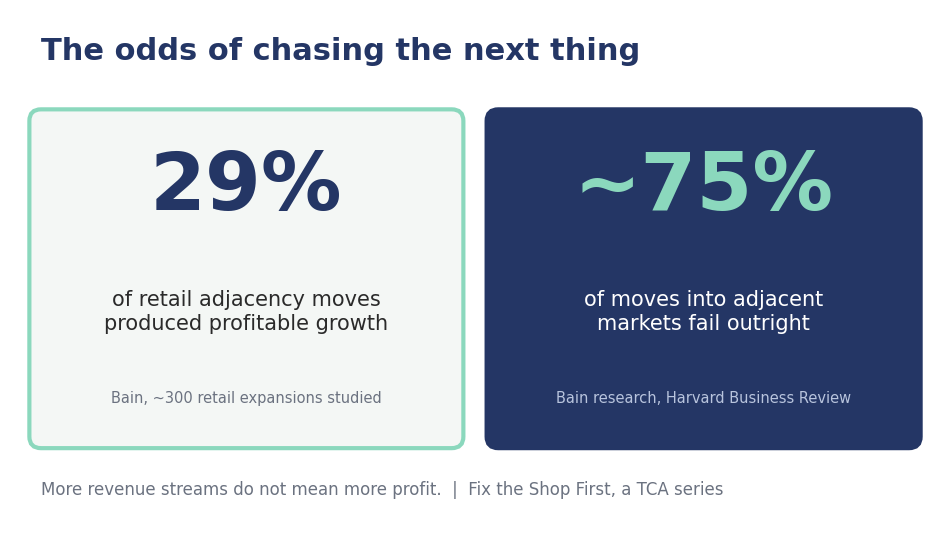
- The research is blunt: Bain found only 29% of retail adjacency moves produced profitable growth, and roughly three-quarters of attempts to grow into adjacent markets fail. The winners almost always had a strong core business first.
- More revenue streams do not mean more profit. Every new offering consumes capital, inventory, training, attention, floor space, and time.
- Broadening your repair capability is not the same as diluting your business model. Repairing more devices is still one business. Running repair plus resale plus IT services plus recycling plus insurance may be several mediocre ones.
- Expand only when the core has earned you the right to expand. This series will show you how to know when that is.
What’s in this post
- What I heard on the show floor
- A week in the life of a distracted owner
- The game has changed: everyone has insurance now
- Why a good idea and hard work are not enough
- What the research says about chasing adjacencies
- Broaden your capability, don’t dilute your model
- You can’t fix what you don’t measure
- Find people who will pick your idea apart
- What’s coming in this series
- Common questions about repair shop focus
What I heard on the show floor
Two weeks ago I spent two days at booth 835 at AWPE in Las Vegas, where the TCA launched TCA ShopCheck. Between demos, I did what I always do at these shows. I talked to operators. Owners of one shop, owners of five, techs planning their first storefront, and veterans who have been at the bench since the first iPhone cracked. Almost all of them want the same thing: to grow a tech repair business that lasts.
Add in the conversations from Mobile Disrupt in Miami back in July and the ITAD Summit in early August, and I’ve spent a lot of 2026 listening to some of the most capable people in this industry. Here’s what struck me most.
It wasn’t the struggling shops that worried me. It was the successful ones.
Some of the sharpest, most productive owners I talked to this summer are wrestling with focus and direction. They have healthy shops, good reputations, and money in the bank, and they’re restless. They’re eyeing spaces that are already crowded with established players. Or they’re gearing up to build something that others in this industry have already tried and failed at, without any real data on what worked and what didn’t the first time around. They have a good idea, they’re willing to outwork anyone, and they assume that combination is enough.
It isn’t. And the numbers on that are brutal, which we’ll get to in a minute.
First, let me describe an owner I met about six times this summer, under six different names and faces.
A week in the life of a distracted owner
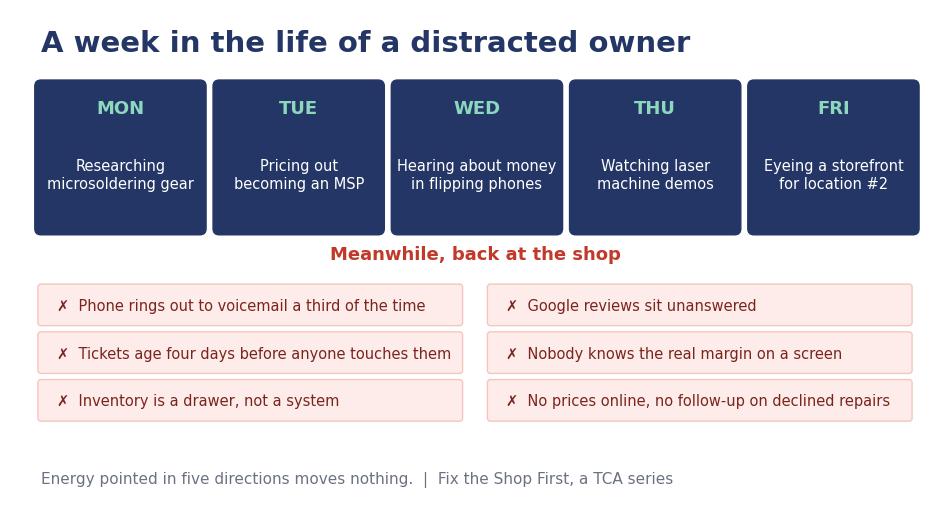
Monday, they’re researching microsoldering equipment. Tuesday, they’re pricing out what it would take to become a managed service provider. Wednesday, a buddy tells them there’s huge money in buying and flipping used phones. Thursday, they’re watching demos of laser machines. Friday, they’re driving past a vacant storefront across town thinking about location number two.
Meanwhile, back at the shop
Back at the shop they already own:
- The phone rings out to voicemail a third of the time.
- Google reviews sit unanswered, including the bad one from last month.
- Repair tickets are aging four days before anyone touches them.
- Nobody, including the owner, knows the actual gross margin on a screen replacement.
- Inventory is a drawer, not a system.
- The website doesn’t show prices.
- Customers who declined a repair never hear from the shop again.
I’m not picking on this owner, whoever they are, wherever you are. I ran a thirteen-location chain back in the day, and I was this owner. And I’ll be the first to admit the game was easier then. The industry has changed, and today’s operators face far more competition than we ever did, from combo shops and kiosks to mobile operators, all fighting for the same customers. That’s an argument for more focus, not less. Repair shop owners are entrepreneurs, and entrepreneurs see opportunity everywhere. Accessories. Used devices. IT services. Data recovery. Recycling. B2B contracts. Mail-in. That instinct built this industry.
But every one of those opportunities consumes some combination of capital, inventory, training, marketing, management attention, floor space, and time. And the TCA’s own research this spring showed exactly where that attention should be going instead. Our May report on why repair shops are losing customers to replacement found that shops are bleeding business over the basics: unanswered calls, poor communication, pricing friction, and a buying experience that makes repair harder to choose than replacement.
Before asking what else you can sell, ask how much more repair business you could capture by getting better at the business you’re already in.
The game has changed: everyone has insurance now
Direct answer
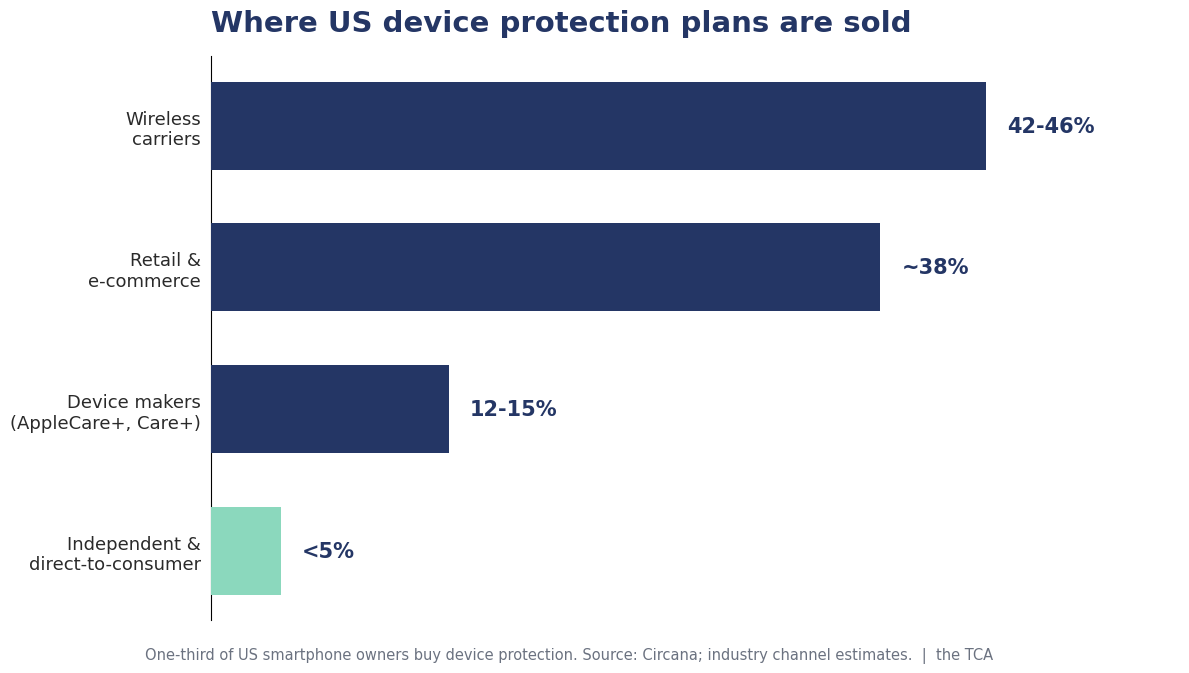
The single most talked-about change in today’s repair world is device protection. One-third of US smartphone owners now purchase protection for their devices, according to consumer tracking firm Circana, and nearly all of those plans are sold through channels that route repairs to a handful of giant operators before an independent shop ever sees the device.
Where the protection plans get sold
Sit with that number. A third of the smartphones in your market may already have a repair path decided before they ever break. And look at where those protection plans get sold. Wireless carriers are the leading channel, bundling protection at the point of sale, with those policies serviced almost entirely by two massive operators. Big-box retail and e-commerce make up the next major slice, powered behind the scenes by the same few giants. Device makers hold a smaller share through their own branded care programs. Independent and direct-to-consumer channels? They control under five percent of the market.
If you read our Operators in Motion piece, this should sound familiar. The two biggest repair-network exits of the last era both landed inside insurance companies, because those companies need repair capability to deliver what they sell. The protection economy sits on top of our industry and pre-routes an enormous share of the work.
Here’s what that means for the thesis of this series. It does not mean run out and start selling protection plans; that’s the chasing reflex this series exists to interrupt, and you’d be walking into the most consolidated corner of the entire market. It means the customers who are still choosing their own repair shop, the majority who skip protection plus everyone whose plan disappoints them, choose on trust, speed, reviews, and experience. The shops that win them are the ones that fixed the shop first. That is how you grow a tech repair business in a market where a third of the customers are spoken for before the screen ever cracks.
Why a good idea and hard work are not enough
Here’s the uncomfortable truth behind those show-floor conversations. A good idea and hard work are the entry fee, not the win condition. Plenty of hard workers fail every year because nobody wants to buy what they built, or because the money ran out before the market showed up. To succeed, you also need at least four other things:
Market demand
People have to want to buy what you’re selling, in your market, at your price. And not every idea or product plays well in every market: what thrives in a college town can starve in a retiree suburb, and what works in a dense city can flop in a rural county. If the market is too small or simply doesn’t care, working harder will not fix it. This is where “the space is already crowded” and “somebody already tried this here and it died” should be treated as data, not as challenges to your pride.
Cash flow
You need money to pay the bills before the new thing turns a profit, and new ventures always take longer than the plan says. Running out of cash is the most common way a new business closes, and it’s how a healthy repair shop gets dragged down by its own side project.
Timing
Launching too early or too late can kill a genuinely great idea. Some of the failures in this industry weren’t bad ideas. They were right ideas at the wrong moment, and the person trying it again five years later without understanding why it failed the first time is set up to repeat the result.
Smart strategy and the right team
Working hard on the wrong tasks wastes the one resource you can’t buy more of. You need a clear plan, the right skills, and people besides yourself who can run the thing.
Part 2 of this series digs into each of these in detail. For now, hold onto the pattern: the graveyard of this industry is full of good ideas executed by hard workers who were missing one of those four ingredients.
What the research says about chasing adjacencies
This isn’t just my read from the show floor. The business research on how companies try to grow, and how often expansion backfires, is remarkably consistent, and remarkably grim.
Bain & Company studied nearly 300 adjacency moves by retailers, meaning expansions into products, services, and markets next to the core business. Only 29% produced profitable growth. Only 15% produced significant increases in both revenue and profit. The strongest predictor of success was how close the expansion stayed to the company’s existing customers, capabilities, and cost structure.
A related Bain study published in Harvard Business Review put it even more starkly: roughly three-quarters of attempts to grow into adjacent markets fail. And the companies that did succeed at adjacency expansion had one thing in common. They already had strong core businesses before they expanded.
Then there’s the complexity problem. Research summarized in Harvard Business Review found that most businesses offer more products and services than the profit-maximizing number. Every additional offering creates operational complexity, and the cost of that complexity quietly eats into margins long before anyone notices it on a spreadsheet.
Put those findings together and you get the sentence I want every shop owner to tape above the bench:
More revenue streams do not mean more profit.
A shop doing $700,000 of complicated, poorly managed business across six ventures is not healthier than a shop doing $500,000 of highly repeatable repair work at strong margins. The second owner sleeps better, banks more, and is in a far stronger position to grow a tech repair business later, on purpose, from strength.
Broaden your capability, don’t dilute your model
Now, if you’ve been reading the TCA blog for a while, you might be raising an eyebrow. Haven’t we spent the past year telling you the opposite?
We published Beyond Phone Repair, showing that your skills already transfer across ten consumer electronics categories. We published Operators in Motion, celebrating owners who grew from the bench into refurbishment, ITAD, resale, and software. We’ve covered data recovery as an expanding profit center. We stand behind every word of it.
This series is not a retraction. It’s the missing chapter.
Here’s the distinction that resolves it. A shop repairing phones, tablets, laptops, consoles, and wearables is still fundamentally running one repair business. Same skills, same workflow, same customer promise, wider funnel. That’s broadening your capability, and it’s usually smart.
A shop simultaneously trying to operate repair plus prepaid wireless plus used-device retail plus IT services plus eBay resale plus recycling plus insurance sales may be running seven mediocre businesses out of one storefront. That’s diluting your model, and it’s usually how good shops become tired shops.

Ask the uncomfortable questions first
So before you bolt anything new onto the counter, ask yourself some uncomfortable questions. Do your customers actually want additional products and services from you, or do they want you to do more of the core repair work they already trust you with? If you sell them something they didn’t come for, can it hurt the business you already have? Do they want to deal with a salesperson or a repair person? And if you push sales too hard, does it damage the trust that drives your repair traffic in the first place? Every one of those answers decides whether you grow a tech repair business or merely complicate one.
My honest take, after two decades in this trade: people come to you for repair, and repair only. Layering sales on top of that relationship is much harder than it looks, and very few shops pull it off without eroding the thing that made customers walk in.
Every operator in motion we profiled earned the move first. Their pattern was never “chase everything.” It was master the core, systemize it, and then expand from strength into work that used the same customers, skills, and trust they’d already built. Expansion is a multiplier. Multiply a strong operation and you get growth. Multiply a broken operation and you get a bigger broken operation.
Expand only when the core has earned you the right to expand.
You can’t fix what you don’t measure
So how do you know whether your core has earned it? You measure it. Honestly, and from the outside. Nobody has ever managed to grow a tech repair business on numbers they didn’t know.
That’s exactly why the TCA built TCA ShopCheck, the free shop health check we launched at AWPE last month. In about two minutes, it scores your business across the five things that actually determine whether the core is strong: whether customers can find you, whether they choose you, whether you win the job, whether you run the operation well, and whether you’re set up to grow. It’s free, it stays free, and it exists because most owners have never had an objective look at their own shop.
Run it before you spend another hour researching that laser machine. If the score stings a little, good. That sting is the gap between the business you have and the business you could have without adding a single new venture.
And keep an eye on this space. TCA ShopCheck is the first tool in what we’re building into a full suite, with more advanced tools coming that go deeper into analyzing your operations, your numbers, and your readiness to expand. The shops that measure will always beat the shops that guess.
Find people who will pick your idea apart
One more thing before I lay out the series, because it came up in almost every one of those show-floor conversations.
The owners chasing crowded spaces and repeating past failures had something in common: everyone around them loved the idea. Their techs loved it. Their regulars loved it. Their Facebook group loved it. What they didn’t have was a single person with real authority and experience whose job was to pick the idea apart.
Your fans are great at identifying their problems and terrible at inventing your solutions. There’s a famous line, probably apocryphal, attributed to Henry Ford: if he’d asked people what they wanted, they’d have said faster horses. Customers ask for incremental versions of what already exists. Your loudest supporters don’t represent your average customer. And people will enthusiastically tell you they want something right up until you ask them to pay for it.
What you need is hard, honest feedback from people with the experience to know where the bodies are buried. People who will ask what the market demand actually is, what happened to the last three shops that tried it, and what your cash position looks like in month nine. That kind of feedback is uncomfortable, and it is worth more than a hundred likes. Part 5 of this series is entirely about where to find it and how to use it.
What’s coming in this series
Over the next several weeks, Fix the Shop First will build the complete argument, and the complete toolkit:
- Stop Chasing the Next Thing: Fix the Shop First (you’re reading it)
- The Industry With No Giants: why an industry this big has no dominant players, and what the churn rate is telling us
- A Good Idea and Hard Work Are Not Enough: the four ingredients that actually determine success
- Do You Actually Have a Profitable Repair Business?: the numbers every owner must know cold
- The Boring Stuff Is Where the Money Is (and Facebook Isn’t): the six figures hiding inside the shop you already own
- Your Fans Are Lying to You (Kindly): how to get feedback that actually protects you
- Everybody’s Right and Everybody’s Wrong: the silo problem, and how to vet the voices you follow
- When You Should Add Something New: the TCA Expansion Test
- Build Your Repair Machine: the TCA Core-First Growth Model
By the end, you’ll have a framework for knowing exactly when your shop has earned the right to expand, a plan for what to do until then, and a clear answer to the question every owner eventually asks: how do I grow a tech repair business without breaking the one I have?
Common questions about repair shop focus
Should a tech repair shop diversify into new revenue streams?
Only after the core repair business is consistently profitable, measured, and able to run without the owner touching everything. Research on business adjacency moves shows roughly three-quarters fail, and the successes almost always came from companies with strong core businesses first. Expansion multiplies whatever you already have, strong or broken.
Is repairing more types of devices the same as diversifying?
No. Adding tablets, laptops, consoles, and wearables to a phone repair shop broadens one repair business using the same skills, workflow, and customer trust. Diversifying means running fundamentally different businesses, like resale, IT services, recycling, and insurance, from the same storefront. The first widens your funnel. The second divides your attention.
How do I know if my repair shop is ready to grow a tech repair business beyond repair?
Start by measuring the core objectively. TCA ShopCheck is a free two-minute health check that scores your shop on getting found, getting chosen, winning the job, running well, and growing. If the core scores strong and you can answer the market demand, cash flow, timing, and team questions honestly, you’re ready to run the TCA Expansion Test coming later in this series.
Want to grow a tech repair business? The next thing can wait. The shop can’t.
If you walked one of those show floors with me this summer, you saw an industry full of energy, ideas, and ambition. That’s our strength. But energy pointed in six directions moves nothing. The owners who win over the next five years won’t be the ones with the most ideas. They’ll be the ones who built one great repair business first, measured it honestly, listened to people willing to tell them the truth, and then expanded from strength.
Next Tuesday, Part 2 asks the question hiding underneath all of this: why has an industry this large produced almost no giants? The answer lives in our brutal churn numbers, a century-old trade route working against us, and a focus problem nobody wants to name. If you’ve ever wondered why the revolving door of shops opening and closing never stops spinning, that post is for you.
Until then, run your shop through TCA ShopCheck. It takes two minutes, it’s free, and it might be the most honest conversation your business has had in years.
How healthy is your shop, really?
TCA ShopCheck is a free two-minute health check built for independent repair shops. No sales pitch, no strings. Just an honest score and a place to start.
More from the TCA Blog
- Operators in Motion: A Repair Shop Growth Playbook
- Why Repair Shops Are Losing Customers to Replacement
- Beyond Phone Repair: Your Skills Already Work on All 10 Consumer Electronics Categories
- Simplifying Your Tech Repair Shop Pricing
Rob Link is the founder of the TCA. He built and ran a multi-location repair chain in an earlier era of this industry, and he’d tell you today’s operators have it harder. The TCA is independent of carriers, manufacturers, and insurance companies, which is exactly why it can tell shop owners the truth about growth.
Sources: Circana, smartphone protection purchase data (2025). Bain & Company, “Growing Beyond Your Core in Retail” (study of nearly 300 retail adjacency moves). Zook & Allen, “Growth Outside the Core,” Harvard Business Review. Gottfredson & Aspinall, “Innovation Versus Complexity: What Is Too Much of a Good Thing?”, Harvard Business Review. The TCA’s State of Tech Repair 2026 research. The Tech Care Association (TCA) is the leading nonprofit trade association for independent tech repair professionals in North America.
