Posts

The most dangerous sentence in tech repair might be “I’ve got another idea.” Before you add another service, product, location, or revenue stream, make the repair business work. If you want to grow a tech repair business, this is where you start. Part 1 of a nine-part TCA series on building from strength.

Fix the Shop First · Part 1 of 9

By Rob Link, Founder & CEO, Tech Care Association · September 1, 2026 · 10 min read

Key Takeaways

  • A good idea and hard work are not enough. You also need market demand, cash flow, the right team, operational planning, and timing. Most hard workers who fail run out of money or build something nobody wants to buy.
  • The research is blunt: Bain found only 29% of retail adjacency moves produced profitable growth, and roughly three-quarters of attempts to grow into adjacent markets fail. The winners almost always had a strong core business first.
  • More revenue streams do not mean more profit. Every new offering consumes capital, inventory, training, attention, floor space, and time.
  • Broadening your repair capability is not the same as diluting your business model. Repairing more devices is still one business. Running repair plus resale plus IT services plus recycling plus insurance may be several mediocre ones.
  • Expand only when the core has earned you the right to expand. This series will show you how to know when that is.

What’s in this post

  1. What I heard on the show floor
  2. A week in the life of a distracted owner
  3. The game has changed: everyone has insurance now
  4. Why a good idea and hard work are not enough
  5. What the research says about chasing adjacencies
  6. Broaden your capability, don’t dilute your model
  7. You can’t fix what you don’t measure
  8. Find people who will pick your idea apart
  9. What’s coming in this series
  10. Common questions about repair shop focus

What I heard on the show floor

Two weeks ago I spent two days at booth 835 at AWPE in Las Vegas, where the TCA launched TCA ShopCheck. Between demos, I did what I always do at these shows. I talked to operators. Owners of one shop, owners of five, techs planning their first storefront, and veterans who have been at the bench since the first iPhone cracked. Almost all of them want the same thing: to grow a tech repair business that lasts.

Add in the conversations from Mobile Disrupt in Miami back in July and the ITAD Summit in early August, and I’ve spent a lot of 2026 listening to some of the most capable people in this industry. Here’s what struck me most.

It wasn’t the struggling shops that worried me. It was the successful ones.

Some of the sharpest, most productive owners I talked to this summer are wrestling with focus and direction. They have healthy shops, good reputations, and money in the bank, and they’re restless. They’re eyeing spaces that are already crowded with established players. Or they’re gearing up to build something that others in this industry have already tried and failed at, without any real data on what worked and what didn’t the first time around. They have a good idea, they’re willing to outwork anyone, and they assume that combination is enough.

It isn’t. And the numbers on that are brutal, which we’ll get to in a minute.

First, let me describe an owner I met about six times this summer, under six different names and faces.

A week in the life of a distracted owner

Monday, they’re researching microsoldering equipment. Tuesday, they’re pricing out what it would take to become a managed service provider. Wednesday, a buddy tells them there’s huge money in buying and flipping used phones. Thursday, they’re watching demos of laser machines. Friday, they’re driving past a vacant storefront across town thinking about location number two.

Meanwhile, back at the shop

Back at the shop they already own:

  • The phone rings out to voicemail a third of the time.
  • Google reviews sit unanswered, including the bad one from last month.
  • Repair tickets are aging four days before anyone touches them.
  • Nobody, including the owner, knows the actual gross margin on a screen replacement.
  • Inventory is a drawer, not a system.
  • The website doesn’t show prices.
  • Customers who declined a repair never hear from the shop again.
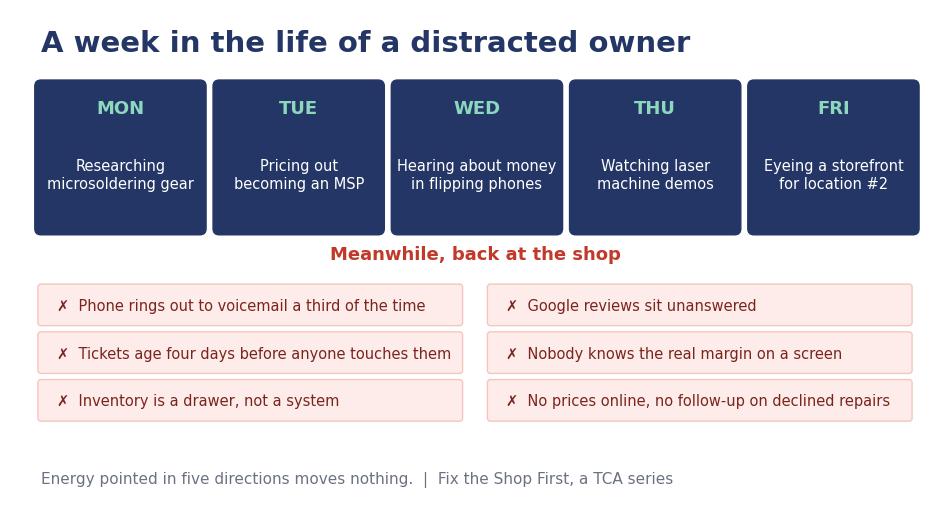
Graphic showing a repair shop owner researching microsoldering, MSP services, phone flipping, laser machines, and a second location Monday through Friday, while unanswered calls, aging tickets, unknown margins, and uncontrolled inventory pile up back at the shop

I’m not picking on this owner, whoever they are, wherever you are. I ran a thirteen-location chain back in the day, and I was this owner. And I’ll be the first to admit the game was easier then. The industry has changed, and today’s operators face far more competition than we ever did, from combo shops and kiosks to mobile operators, all fighting for the same customers. That’s an argument for more focus, not less. Repair shop owners are entrepreneurs, and entrepreneurs see opportunity everywhere. Accessories. Used devices. IT services. Data recovery. Recycling. B2B contracts. Mail-in. That instinct built this industry.

But every one of those opportunities consumes some combination of capital, inventory, training, marketing, management attention, floor space, and time. And the TCA’s own research this spring showed exactly where that attention should be going instead. Our May report on why repair shops are losing customers to replacement found that shops are bleeding business over the basics: unanswered calls, poor communication, pricing friction, and a buying experience that makes repair harder to choose than replacement.

Before asking what else you can sell, ask how much more repair business you could capture by getting better at the business you’re already in.

The game has changed: everyone has insurance now

Direct answer
The single most talked-about change in today’s repair world is device protection. One-third of US smartphone owners now purchase protection for their devices, according to consumer tracking firm Circana, and nearly all of those plans are sold through channels that route repairs to a handful of giant operators before an independent shop ever sees the device.

Where the protection plans get sold

Sit with that number. A third of the smartphones in your market may already have a repair path decided before they ever break. And look at where those protection plans get sold. Wireless carriers are the leading channel, bundling protection at the point of sale, with those policies serviced almost entirely by two massive operators. Big-box retail and e-commerce make up the next major slice, powered behind the scenes by the same few giants. Device makers hold a smaller share through their own branded care programs. Independent and direct-to-consumer channels? They control under five percent of the market.
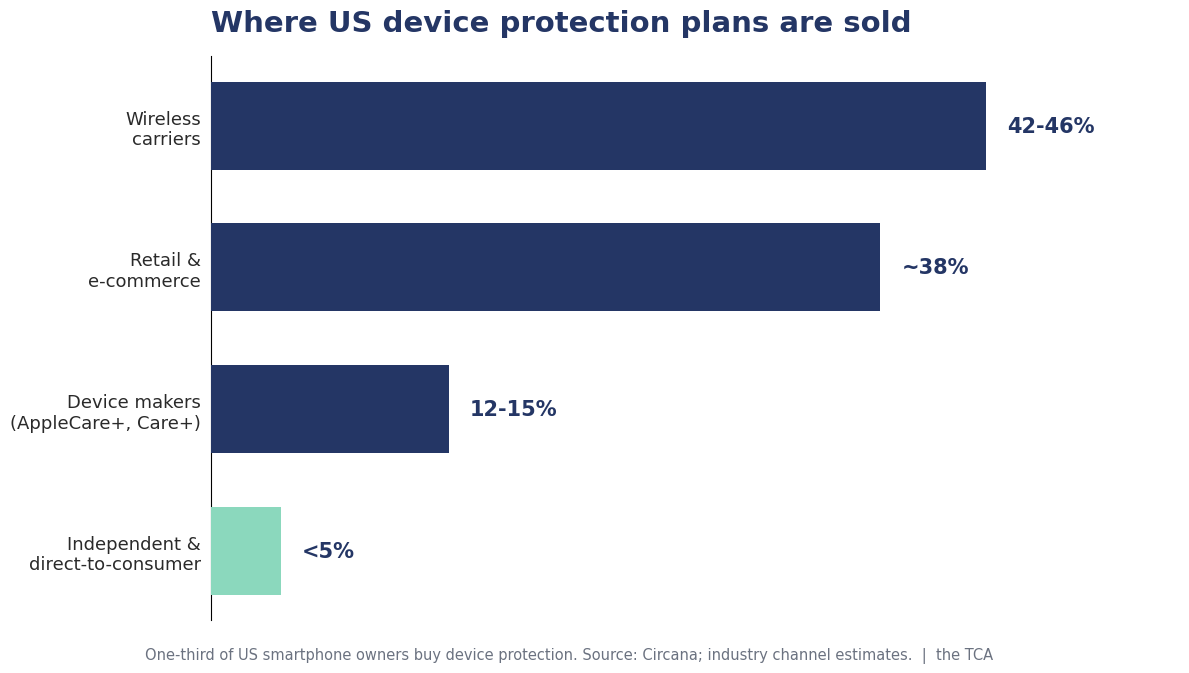
Bar chart showing where US device protection plans are sold: wireless carriers lead at roughly 44 percent, retailers and e-commerce near 38 percent, device manufacturers around 13 percent, and independent channels under 5 percent

If you read our Operators in Motion piece, this should sound familiar. The two biggest repair-network exits of the last era both landed inside insurance companies, because those companies need repair capability to deliver what they sell. The protection economy sits on top of our industry and pre-routes an enormous share of the work.

Here’s what that means for the thesis of this series. It does not mean run out and start selling protection plans; that’s the chasing reflex this series exists to interrupt, and you’d be walking into the most consolidated corner of the entire market. It means the customers who are still choosing their own repair shop, the majority who skip protection plus everyone whose plan disappoints them, choose on trust, speed, reviews, and experience. The shops that win them are the ones that fixed the shop first. That is how you grow a tech repair business in a market where a third of the customers are spoken for before the screen ever cracks.

Why a good idea and hard work are not enough

Here’s the uncomfortable truth behind those show-floor conversations. A good idea and hard work are the entry fee, not the win condition. Plenty of hard workers fail every year because nobody wants to buy what they built, or because the money ran out before the market showed up. To succeed, you also need at least four other things:

Market demand

People have to want to buy what you’re selling, in your market, at your price. And not every idea or product plays well in every market: what thrives in a college town can starve in a retiree suburb, and what works in a dense city can flop in a rural county. If the market is too small or simply doesn’t care, working harder will not fix it. This is where “the space is already crowded” and “somebody already tried this here and it died” should be treated as data, not as challenges to your pride.

Cash flow

You need money to pay the bills before the new thing turns a profit, and new ventures always take longer than the plan says. Running out of cash is the most common way a new business closes, and it’s how a healthy repair shop gets dragged down by its own side project.

Timing

Launching too early or too late can kill a genuinely great idea. Some of the failures in this industry weren’t bad ideas. They were right ideas at the wrong moment, and the person trying it again five years later without understanding why it failed the first time is set up to repeat the result.

Smart strategy and the right team

Working hard on the wrong tasks wastes the one resource you can’t buy more of. You need a clear plan, the right skills, and people besides yourself who can run the thing.

Part 2 of this series digs into each of these in detail. For now, hold onto the pattern: the graveyard of this industry is full of good ideas executed by hard workers who were missing one of those four ingredients.

What the research says about chasing adjacencies

This isn’t just my read from the show floor. The business research on how companies try to grow, and how often expansion backfires, is remarkably consistent, and remarkably grim.

Bain & Company studied nearly 300 adjacency moves by retailers, meaning expansions into products, services, and markets next to the core business. Only 29% produced profitable growth. Only 15% produced significant increases in both revenue and profit. The strongest predictor of success was how close the expansion stayed to the company’s existing customers, capabilities, and cost structure.

A related Bain study published in Harvard Business Review put it even more starkly: roughly three-quarters of attempts to grow into adjacent markets fail. And the companies that did succeed at adjacency expansion had one thing in common. They already had strong core businesses before they expanded.

Then there’s the complexity problem. Research summarized in Harvard Business Review found that most businesses offer more products and services than the profit-maximizing number. Every additional offering creates operational complexity, and the cost of that complexity quietly eats into margins long before anyone notices it on a spreadsheet.
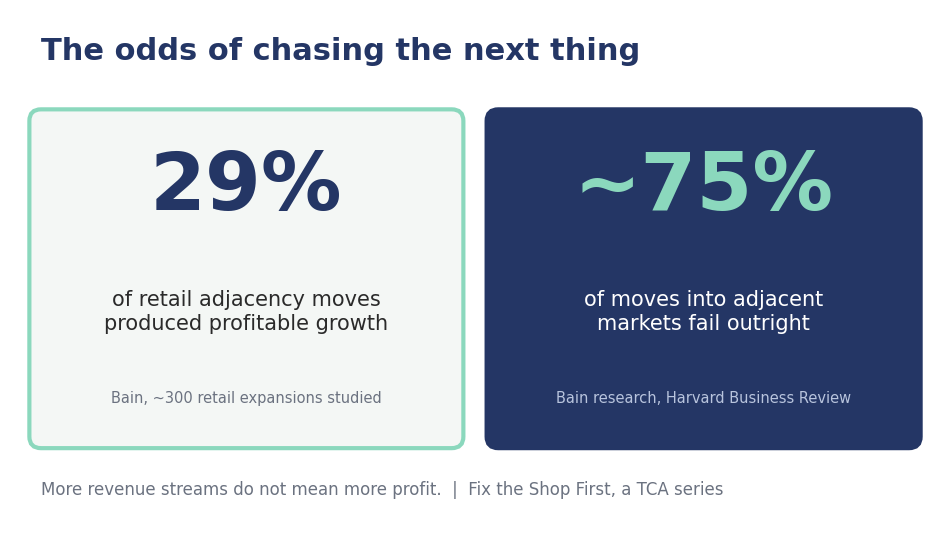
Stat graphic on why chasing adjacencies is a risky way to grow a tech repair business: only 29 percent of retail adjacency moves produced profitable growth and roughly 75 percent of adjacent market expansion attempts fail, per Bain research

Put those findings together and you get the sentence I want every shop owner to tape above the bench:

More revenue streams do not mean more profit.

A shop doing $700,000 of complicated, poorly managed business across six ventures is not healthier than a shop doing $500,000 of highly repeatable repair work at strong margins. The second owner sleeps better, banks more, and is in a far stronger position to grow a tech repair business later, on purpose, from strength.

Broaden your capability, don’t dilute your model

Now, if you’ve been reading the TCA blog for a while, you might be raising an eyebrow. Haven’t we spent the past year telling you the opposite?

We published Beyond Phone Repair, showing that your skills already transfer across ten consumer electronics categories. We published Operators in Motion, celebrating owners who grew from the bench into refurbishment, ITAD, resale, and software. We’ve covered data recovery as an expanding profit center. We stand behind every word of it.

This series is not a retraction. It’s the missing chapter.

Here’s the distinction that resolves it. A shop repairing phones, tablets, laptops, consoles, and wearables is still fundamentally running one repair business. Same skills, same workflow, same customer promise, wider funnel. That’s broadening your capability, and it’s usually smart.

A shop simultaneously trying to operate repair plus prepaid wireless plus used-device retail plus IT services plus eBay resale plus recycling plus insurance sales may be running seven mediocre businesses out of one storefront. That’s diluting your model, and it’s usually how good shops become tired shops.

Comparison graphic: one repair business covering phones, tablets, laptops, consoles, and wearables versus eight separate businesses crammed into one storefront, illustrating broadening capability versus diluting the business model

Ask the uncomfortable questions first

So before you bolt anything new onto the counter, ask yourself some uncomfortable questions. Do your customers actually want additional products and services from you, or do they want you to do more of the core repair work they already trust you with? If you sell them something they didn’t come for, can it hurt the business you already have? Do they want to deal with a salesperson or a repair person? And if you push sales too hard, does it damage the trust that drives your repair traffic in the first place? Every one of those answers decides whether you grow a tech repair business or merely complicate one.

My honest take, after two decades in this trade: people come to you for repair, and repair only. Layering sales on top of that relationship is much harder than it looks, and very few shops pull it off without eroding the thing that made customers walk in.

Every operator in motion we profiled earned the move first. Their pattern was never “chase everything.” It was master the core, systemize it, and then expand from strength into work that used the same customers, skills, and trust they’d already built. Expansion is a multiplier. Multiply a strong operation and you get growth. Multiply a broken operation and you get a bigger broken operation.

Expand only when the core has earned you the right to expand.

You can’t fix what you don’t measure

So how do you know whether your core has earned it? You measure it. Honestly, and from the outside. Nobody has ever managed to grow a tech repair business on numbers they didn’t know.

That’s exactly why the TCA built TCA ShopCheck, the free shop health check we launched at AWPE last month. In about two minutes, it scores your business across the five things that actually determine whether the core is strong: whether customers can find you, whether they choose you, whether you win the job, whether you run the operation well, and whether you’re set up to grow. It’s free, it stays free, and it exists because most owners have never had an objective look at their own shop.

Run it before you spend another hour researching that laser machine. If the score stings a little, good. That sting is the gap between the business you have and the business you could have without adding a single new venture.

And keep an eye on this space. TCA ShopCheck is the first tool in what we’re building into a full suite, with more advanced tools coming that go deeper into analyzing your operations, your numbers, and your readiness to expand. The shops that measure will always beat the shops that guess.

Find people who will pick your idea apart

One more thing before I lay out the series, because it came up in almost every one of those show-floor conversations.

The owners chasing crowded spaces and repeating past failures had something in common: everyone around them loved the idea. Their techs loved it. Their regulars loved it. Their Facebook group loved it. What they didn’t have was a single person with real authority and experience whose job was to pick the idea apart.

Your fans are great at identifying their problems and terrible at inventing your solutions. There’s a famous line, probably apocryphal, attributed to Henry Ford: if he’d asked people what they wanted, they’d have said faster horses. Customers ask for incremental versions of what already exists. Your loudest supporters don’t represent your average customer. And people will enthusiastically tell you they want something right up until you ask them to pay for it.

What you need is hard, honest feedback from people with the experience to know where the bodies are buried. People who will ask what the market demand actually is, what happened to the last three shops that tried it, and what your cash position looks like in month nine. That kind of feedback is uncomfortable, and it is worth more than a hundred likes. Part 5 of this series is entirely about where to find it and how to use it.

What’s coming in this series

Over the next several weeks, Fix the Shop First will build the complete argument, and the complete toolkit:

  1. Stop Chasing the Next Thing: Fix the Shop First (you’re reading it)
  2. The Industry With No Giants: why an industry this big has no dominant players, and what the churn rate is telling us
  3. A Good Idea and Hard Work Are Not Enough: the four ingredients that actually determine success
  4. Do You Actually Have a Profitable Repair Business?: the numbers every owner must know cold
  5. The Boring Stuff Is Where the Money Is (and Facebook Isn’t): the six figures hiding inside the shop you already own
  6. Your Fans Are Lying to You (Kindly): how to get feedback that actually protects you
  7. Everybody’s Right and Everybody’s Wrong: the silo problem, and how to vet the voices you follow
  8. When You Should Add Something New: the TCA Expansion Test
  9. Build Your Repair Machine: the TCA Core-First Growth Model

By the end, you’ll have a framework for knowing exactly when your shop has earned the right to expand, a plan for what to do until then, and a clear answer to the question every owner eventually asks: how do I grow a tech repair business without breaking the one I have?

Common questions about repair shop focus

Should a tech repair shop diversify into new revenue streams?

Only after the core repair business is consistently profitable, measured, and able to run without the owner touching everything. Research on business adjacency moves shows roughly three-quarters fail, and the successes almost always came from companies with strong core businesses first. Expansion multiplies whatever you already have, strong or broken.

Is repairing more types of devices the same as diversifying?

No. Adding tablets, laptops, consoles, and wearables to a phone repair shop broadens one repair business using the same skills, workflow, and customer trust. Diversifying means running fundamentally different businesses, like resale, IT services, recycling, and insurance, from the same storefront. The first widens your funnel. The second divides your attention.

How do I know if my repair shop is ready to grow a tech repair business beyond repair?

Start by measuring the core objectively. TCA ShopCheck is a free two-minute health check that scores your shop on getting found, getting chosen, winning the job, running well, and growing. If the core scores strong and you can answer the market demand, cash flow, timing, and team questions honestly, you’re ready to run the TCA Expansion Test coming later in this series.

Want to grow a tech repair business? The next thing can wait. The shop can’t.

If you walked one of those show floors with me this summer, you saw an industry full of energy, ideas, and ambition. That’s our strength. But energy pointed in six directions moves nothing. The owners who win over the next five years won’t be the ones with the most ideas. They’ll be the ones who built one great repair business first, measured it honestly, listened to people willing to tell them the truth, and then expanded from strength.

Next Tuesday, Part 2 asks the question hiding underneath all of this: why has an industry this large produced almost no giants? The answer lives in our brutal churn numbers, a century-old trade route working against us, and a focus problem nobody wants to name. If you’ve ever wondered why the revolving door of shops opening and closing never stops spinning, that post is for you.

Until then, run your shop through TCA ShopCheck. It takes two minutes, it’s free, and it might be the most honest conversation your business has had in years.

How healthy is your shop, really?

TCA ShopCheck is a free two-minute health check built for independent repair shops. No sales pitch, no strings. Just an honest score and a place to start.

Run TCA ShopCheck Free

More from the TCA Blog

Rob Link is the founder of the TCA. He built and ran a multi-location repair chain in an earlier era of this industry, and he’d tell you today’s operators have it harder. The TCA is independent of carriers, manufacturers, and insurance companies, which is exactly why it can tell shop owners the truth about growth.

Sources: Circana, smartphone protection purchase data (2025). Bain & Company, “Growing Beyond Your Core in Retail” (study of nearly 300 retail adjacency moves). Zook & Allen, “Growth Outside the Core,” Harvard Business Review. Gottfredson & Aspinall, “Innovation Versus Complexity: What Is Too Much of a Good Thing?”, Harvard Business Review. The TCA’s State of Tech Repair 2026 research. The Tech Care Association (TCA) is the leading nonprofit trade association for independent tech repair professionals in North America.

From cracked screens to enterprise processing, the entrepreneurs building the future of the $40 billion Tech Care Industry prove that the repair bench can be a starting line, not a destination.

Series B: Business Opportunities · State of Tech Repair 2026

By Rob Link, Founder & CEO, Tech Care Association · June 15, 2026 · 13 min read

Key Takeaways

  • The Tech Care Industry is one connected ecosystem of repair, support, returns, refurbishment, data destruction, resale, and recycling. Independent repair shops are its foundation, not a separate world.
  • Operators in motion are repair shop owners who treat the bench as a starting line and build toward owning more of the device lifecycle, or building tools and services the industry needs.
  • Repair shop growth into a larger operation like refurbishment, IT asset disposition, software, and resale is a proven path. uBreakiFix, iCracked, Gopher Mods, Refreshed Tech, and eWaste Direct all started small.
  • The US tech repair market is about $40 billion, with close to 40,000 independent tech repair shops across North America.
  • Staying a great local lifestyle business is an equally valid choice. Both paths are winning.

What's in this post

  1. What is the Tech Care Industry?
  2. The Tech Care Value Chain
  3. What is an operator in motion?
  4. Most repair shops are lifestyle businesses
  5. The companies that started small
  6. Two ways to win
  7. Common questions about repair shop growth

Not long ago I was talking shop with someone in the industry. He knows the market well. But the longer we talked, the clearer one thing got. He saw the big companies and the small ones as two separate worlds. On one side, the enterprise asset-disposition firms, the bulk wholesalers, the refurbished marketplaces, the recyclers. On the other, the local shop with a bench and a sign in the window. To him they barely belonged in the same conversation.

I see it the other way around. They are not two worlds. They are one industry, and every layer of it leans on the others to stand up.

What is the Tech Care Industry?

Direct answer
The Tech Care Industry is the full ecosystem that keeps the world's devices working, supported, moving, and out of the landfill: tech support, repair, returns and reverse logistics, IT asset disposition, refurbishment, resale, and recycling. Independent tech repair shops are the frontline of this industry, and the larger players that sit above them depend on that frontline to function.

I started calling this whole thing the Tech Care Industry back in 2020, when I founded the TCA, because that is what it is. The Tech Care Industry is the business of keeping the world's devices working, supported, moving, and out of the landfill for as long as possible. The repair piece alone is roughly a forty-billion-dollar market in the United States, a number the TCA broke down in The $40B Truth. Add asset disposition, refurbishment, wholesale distribution, and recycling on top of that, worldwide, and the full industry runs several times larger. The exact totals swing depending on who is counting. The scale does not.

Picture how a single device moves through the Tech Care Industry. Someone buys a phone or a laptop. Right away, plenty of people need help setting it up, moving their data, or solving a problem they cannot crack alone, and tech support handles that, on day one and for years after. Many devices do not even stay bought. They come back, for buyer's remorse, a defect, the wrong model, a hundred reasons, and the reverse logistics industry processes that flood. The scale is staggering. Reverse logistics is worth more than a trillion dollars worldwide in 2026, and the slice dedicated to electronics alone, covering e-waste recycling, device repair, and asset recovery, is a market of about $18.7 billion, according to Fortune Business Insights. When a device breaks, the frontline is a repair shop, local independent or big retail chain. When a company retires a fleet of hundreds or thousands of machines, asset-disposition firms and data-destruction specialists wipe the drives to certified standards and sort what can live again from what cannot. The survivors flow into wholesale channels, get tested and graded by software, and move by the pallet to distributors, then on to refurbished marketplaces for resale. The ones that are truly finished go to certified recyclers, who pull out the gold, copper, and other materials and keep the toxic parts out of the ground. It is a loop, not a straight line.

Two giant industries sit on top of all this and rely on it completely, even though they are not really part of it. Insurance companies cannot pay out a device-protection claim without a repair network or a refurbished replacement to draw on. Wireless carriers cannot move a single traded-in phone without the refurbishers, wholesalers, and recyclers downstream. Both industries are bigger and richer than tech care, and both quietly depend on it to function. The repair shop does not work for them. They work because of it.

Here is what my colleague missed. None of those layers work without the others. Marketplaces do not generate inventory; they depend on refurbishers and shops to supply it. Wholesalers depend on a steady stream of devices coming up from repair counters and corporate trade-ins. Recyclers depend on the whole chain routing dead units their way. And the local shop, in turn, runs on the parts, software, and resale platforms the bigger players built. Pull out any one layer and the rest wobble. Co-existence is not a feel-good idea here. It is the structure.

And here is the part that should matter most to the companies at the top of that chain. The big players were not born big. Most started at the bench, which is the whole reason for this article. So the smart move for the larger players is not to look down on the small shops. It is to help them succeed, the way a good senior staffer mentors a new hire. Not out of charity, out of self-interest. Today's one-person shop is tomorrow's regional processor, software vendor, supplier, or acquisition target. Strengthen the base and you strengthen your own supply. Ignore it or talk down to it, the way my colleague did, and you are sawing at the branch you sit on.

The giant was small once.

The Tech Care Value Chain

Independent repair shops touch nearly every stage of the device lifecycle. That is the whole thesis in one picture.

Buy & use Support Repair Returns ITAD &data wipe Wholesale& grading Recycle Resale THE TECH CARE INDUSTRY one connected loop
The device lifecycle runs as a loop. A repaired phone goes back into use, a refurbished one gets resold, and the work flows on. Independent shops sit at the center of it.

What is an operator in motion?

Operators in motion are repair shop owners who treat the bench as a starting line, not a destination, and build toward something larger. Operators in motion generally move in one of two directions:

  • Owning more of the device lifecycle: sourcing, refurbishment, data sanitization, and resale at volume.
  • Building the tools and services the industry needs: software, marketing and advertising platforms, distribution, and training, anything that makes the trade work better and helps more people in it.

An operator in motion runs the same diagnostics and board-level repairs as everyone else, but looks at a broken phone and sees more than a repair ticket. They see one move in a much bigger game, and they decide to play more of it. It is a mindset before it is a business plan. The most interesting repair shop growth right now belongs to the owners who think that way.

The bench is not always the destination. Sometimes it is the starting line.

Are you an operator in motion?

Check every box that sounds like you, then add them up.

  • ☐  You already resell devices.
  • ☐  You have thought about B2B or fleet contracts.
  • ☐  You buy inventory instead of waiting for walk-ins.
  • ☐  You enjoy building systems and processes.
  • ☐  You see opportunities beyond the repair ticket.
  • ☐  You regularly attend industry events.

Your score

  • 0–2 · Lifestyle Builder. You are running the business on your own terms, and that is a win.
  • 3–4 · Emerging Operator. You are already moving. Pick one next step.
  • 5–6 · Operator in Motion. The bench is your starting line. Go build.

Most repair shops are lifestyle businesses, and that is fine

Most coverage of independent repair still treats the shop as a fixed object. A storefront. A bench. A queue of cracked screens. And for a lot of owners, that is exactly the point.

A huge share of repair shops are lifestyle businesses. A lifestyle business is one built to give its owner a specific way of living, rather than to chase rapid growth, massive scale, or a corporate buyout. The goal is freedom, flexibility, and a good living on your own terms. You set your hours, answer to no one, make enough to live well, and go home. That is a completely legitimate reason to own a shop, and plenty of the best operators in this trade want nothing more. Not everyone wants the grind of building something bigger. That is okay.

But a segment of this industry does want more. They have never seen the bench as the destination. They treat it as a starting line. The companies below are proof of where that mindset can lead.

The companies that started small

The on-ramp from a repair bench to something much larger has been there since the iPhone era began. Look across these companies and the shared DNA is obvious. Every one started small, with no outside money and no warehouse. Every one used skills a good shop already owns. Every one kept more devices in use and out of the ground.

uBreakiFix and iCracked: the early playbook

uBreakiFix started in 2009, when Justin Wetherill shattered his new iPhone, balked at the repair price, and fixed it himself with parts and instructions he found online. He and two friends from the University of Central Florida turned that into a single Orlando storefront, then a franchise. By 2017 they had opened their 500th location. In 2019, with more than 500 stores and a quarter of a billion dollars in annual revenue, uBreakiFix was acquired by Asurion. Today it runs more than 700 locations under the Asurion banner. One cracked screen became a national chain.

iCracked took a different route to the same place. AJ Forsythe kept breaking his iPhone as a Cal Poly student, taught himself to fix it, and started repairing classmates' phones for seventy-five dollars out of his dorm room. With co-founders Anthony Martin and Leslee Lambert, he built that into a Y Combinator-backed network of on-demand technicians, the iTechs. By 2014 iCracked was doing twenty-five million dollars in revenue. At its peak the network reached more than sixty major metro areas across the United States and Canada. On February 11, 2019, iCracked was acquired by the insurance giant Allstate and folded into SquareTrade, the device-warranty business Allstate already owned. The repair was just the door in.

Notice where both companies ended up. uBreakiFix went to Asurion. iCracked went to Allstate. The two biggest repair-network exits of that era both landed inside insurance and warranty companies. That is not a coincidence. Those industries rely on repair and refurbishment to deliver what they sell, so when they wanted to own that capability outright, they bought it. The giants on top of this industry need the people inside it. They proved it with their checkbooks.

Gopher Mods: from a dorm room to a warehouse

Gopher Mods started about as small as a company can start. Casey Profita was a freshman at the University of Minnesota building custom video game controllers out of Pioneer Hall. After graduating, he skipped grad school and bet on repair, becoming one of the first shops in the Twin Cities to offer iPhone repair outside an Apple store. That bet built a real business: multiple retail locations, roughly fifty employees, around 50,000 devices serviced a year, and close to half a million devices kept out of the landfill over fifteen years.

The part worth studying is what came next. In 2025, Gopher Mods closed its flagship Minneapolis retail store and said plainly why. The business was shifting away from individual walk-in consumers and toward school districts, small businesses, and ecommerce, run out of a warehouse instead of a storefront. Read quickly, that looks like a store closing. Read closely, it is an operator in motion repositioning up the value chain, trading foot traffic for fleet contracts and online volume. Same skills, same brand, different altitude.

Refreshed Tech: from his own cracked phone to 105,000 square feet

If Gopher Mods shows the pivot in progress, Refreshed Tech shows where it can lead. Kyle Wainwright started in 2012 by fixing his own broken phone. That turned into Genius Computer and Phone Repair, an eighteen-location retail chain. Then he moved the whole operation into bulk IT asset disposition and refurbishment. Today Refreshed Tech runs a 105,000-square-foot processing facility with more than 150 employees and does millions in sales.

Kyle Wainwright did not start with enterprise contracts or a warehouse. He started with one device and one customer, the same way a lot of shop owners reading this did. The walk-in counter was the on-ramp, not the ceiling.

eWaste Direct: from an eBay side hustle to a fleet on the road

Not every operator in motion starts behind a repair counter. Some start at a kitchen table. Joe Nelson and Angie Cardona-Nelson began flipping electronics on eBay around 2008, about a year after the first iPhone shipped. It was a side hustle. Eighteen years later, eWaste Direct is an electronics recycling and refurbishment company just outside San Francisco with more than a dozen employees and a fleet of vehicles that collects old laptops, phones, and tablets from businesses across the region.

The mechanics will look familiar to anyone in this trade. Devices come in by the pallet. Each one runs through diagnostics. The ones with value get refurbished and resold, with anywhere from 1,200 to 2,000 items listed at any given time. The ones without value get responsibly recycled. Data gets wiped to government sanitization standards as part of the process, which is a paid service in its own right, not an afterthought. A couple flipping phones on eBay quietly became a regional collection and processing operation. That is the whole pattern in one sentence.

Some of them built the software

Here is a twist on the pattern. A few operators in motion did not just scale a shop. They built the tools the rest of the industry now runs on.

Fixably is the clearest example. CEO Joel Mansnerus started an electronics and Apple device repair business in 2010. He and his co-founders built the software to manage and scale their own shop, then commercialized it in 2015. The product came straight off the bench. MyRepairApp came the same way. Tony Tyshchuk built it out of firsthand experience running a repair business, solving his own problems first and turning the fix into a product.

AdCentral runs through the same kind of operator. Co-founder Israel Quintal entered repair in 2013 and went on to own fourteen physical repair shops. He also spent time as an executive at MobileSentrix, one of the largest parts suppliers in the trade. Then he co-founded AdCentral to build software and digital tools for the electronics retail and repair space. Fourteen storefronts and a parts-industry seat became a software company.

Not every tool in this space came straight from a shop. RepairDesk founder Usman Butt started his career in software development, then saw the inefficiencies of repair up close while spending time at his brother's cell phone repair shop and built for them. The point holds either way. Some of these founders stood at the bench and some stood right next to it, but the bench shaped the tools. There is a real chance the point-of-sale, ticketing, or inventory software running in your shop was designed by someone who knew the work because they lived it.

They started small

Company Started as What it became
uBreakiFix One cracked iPhone, 2009 700+ locations, acquired by Asurion
iCracked Dorm-room screen repair, 2010 60+ metro network, acquired by Allstate
Gopher Mods Dorm-room game controllers Multi-store chain, then B2B and ecommerce warehouse
Refreshed Tech Fixing his own phone, 2012 105,000 sq ft ITAD facility, 150+ employees
eWaste Direct eBay side hustle, ~2008 Regional collection, refurbishment, and recycling fleet

A young market with room to move

It is easy to assume the secondary market has always been here. It has not. It is barely older than the iPhone. The secondary market for mobile phones really emerged in 2007 and 2008, right alongside the first iPhone and the first modern Android devices. As people upgraded to premium, high-cost smartphones, their displaced older models started piling up, the 3G and early 4G handsets nobody knew what to do with. That pile is what sparked the first real buy-back and trade-in programs. Everything that came after, the marketplaces, the wholesalers, the grading standards, grew out of that moment.

That makes the secondary market less than twenty years old. The rules are still being written. The standards are still settling. That is not a reason to wait. It is the reason there is still so much room to move.

The platforms they plug into

A generation ago, scaling like this meant building global reach from scratch. That is no longer true, and it is a big reason these stories are becoming more common. Marketplaces like Back Market and Reebelo built the grading standards, quality control, and buyer trust that let independent refurbishers sell at volume far beyond their own zip code. Back Market grew that model into a multibillion-dollar business. Reebelo pulled a fragmented field of small refurbishers into a single trusted storefront. Live-selling channels like Whatnot and TikTok Shop opened another lane entirely, and sellers have scaled refurbished-device sales by moving inventory in front of a camera instead of a display case.

Here is the part worth sitting with. Those platforms do not compete with independent shops so much as depend on them. The inventory and refurbishment skill flowing into the secondary market comes, in large part, from operators like the ones above. Independent shops are not adjacent to that economy. They are its supply.

And plenty of shops are already in it without calling it that. Lots of repair shops refurbish and resell devices at some level already, right alongside the repairs. Many go a step further and buy pallets of lower-grade returns, fix what they can, and move them back into the market at a margin. The line between a repair shop and a small refurbisher is already blurry. That is the point. Stepping up is far less of a leap than it looks from the bench.

What actually changes when a shop scales

When a shop becomes a lifecycle operator, three things change underneath it:

  • Sourcing. Instead of waiting for a customer with a cracked screen, the operator buys devices in volume from school districts, corporate fleets, and carrier trade-in programs. Supply becomes something you go get, not something that walks in.
  • Processing. One-by-one repair gives way to assembly-line testing, automated data erasure and certification, and refurbishment at scale. The craft that made you good at a single repair becomes a system.
  • Liquidation. The display case is replaced by marketplaces and live-selling channels that move graded inventory at a volume no storefront can match.

None of those three require talent a strong repair shop does not already have. Diagnostics, board-level skill, careful data handling, and earned customer trust are exactly the inputs the larger reuse economy runs on. And the operators scaling fastest are also the ones diverting the most e-waste, which is the rare case where the business case and the right thing to do point in the same direction.

The frontline of the Tech Care Industry

Step back from the success stories for a second, because they rest on something bigger than themselves.

$40B
US tech repair market
~40,000
Independent shops, North America
$1T+
Global reverse logistics, 2026
2007–08
Secondary market began

There are close to 40,000 independent tech repair shops across North America. That is the base of this entire industry. The TCA has documented both the size of this market and the pressure these shops are under, and the headline is simple: this layer is large, foundational, and fragile. Every operator in motion in this article started as one of those shops. Every marketplace, refurbisher, and recycler moving used devices at scale is drawing, directly or indirectly, on the work those shops do.

So when someone treats repair people as a world apart from the big players, they have it backwards. This trade is not a lower rung or a separate lane. It is the ground floor of everything built above it. Which is why supporting independent shops is not charity or nostalgia. It is the industry protecting its own foundation, especially with roughly one in three shops exiting every year.

Strengthen the frontline and you strengthen everything above it.

Two ways to win

None of this means scaling is the goal. It is one good path, not the only one, and not the right one for everyone. Think about the restaurant business. A handful of operators build national chains. Most of the great ones never do, and never want to. The best restaurant in your town is not a failed franchise. It is a destination. The owner knows the regulars by name, controls the quality personally, and builds something a five-hundred-location chain can never copy.

Repair is the same. Being the best shop in your community, the one people trust with their broken laptop and their kid's first phone, is not a consolation prize for the shops that did not scale. For a lot of owners it is the entire point. An operator in motion and a great local fixture are both winning. They are just playing different games.

Lifestyle Business

A destination

  • Freedom and flexibility
  • Community relationships
  • Personal craftsmanship
  • Local reputation
  • Stable income and quality of life

Operator in Motion

A starting line

  • Regional influence
  • Enterprise relationships
  • Building teams and systems
  • New revenue streams
  • Industry impact

Neither path is wrong. The key is choosing on purpose.

Common questions about repair shop growth

Can a repair shop grow into a larger business?

Yes. Repair shop growth into a larger operation like refurbishment, IT asset disposition, software, and resale at scale is a proven path, and it does not require talent a strong shop does not already have. uBreakiFix, iCracked, Gopher Mods, Refreshed Tech, and eWaste Direct all started with one device or one side hustle and built much larger lifecycle businesses on the same core skills: diagnostics, board-level repair, careful data handling, and earned customer trust.

Do refurbished marketplaces compete with independent repair shops?

Mostly no. Marketplaces such as Back Market and Reebelo do not generate their own inventory or refurbishment skill. They depend on independent shops and refurbishers to supply both. Independent repair shops are the supply side of the secondary market, not its competition, which means stepping into refurbishment and resale is closer to a natural extension than a head-to-head fight.

Is the secondary market still a good opportunity to enter?

Yes. The secondary market for mobile phones only emerged around 2007 and 2008, which makes it less than twenty years old. Standards, grading, and channels are still settling, and the reverse logistics that feeds the secondary market is already worth more than a trillion dollars worldwide. For repair shop owners, that means there is still meaningful room to move.

The choice in front of you

Either way, the choice is worth making on purpose. The value in this industry keeps moving downstream of the repair counter, into sourcing, processing, software, support, and resale at scale. If you want a bigger piece of that, the door is open and more reachable than most people think. If you want to run the best lifestyle shop in your town, that door is open too. The question is not whether you can fix the phone. It is what you want the phone to be: the end of a transaction, or the start of something you decide to build.

One move helps no matter which path you pick. Get in the room. Operators in motion already do this. They show up where distributors, refurbishers, software companies, recyclers, and marketplaces are all under one roof, and they leave with relationships that turn a shop into something larger. But you do not have to be chasing scale to benefit. Every owner who shows up finds better parts deals, new referral partners, sharper suppliers, and ideas they did not walk in with. The whole industry gets stronger when more of us are in the same room.

One of those rooms is happening soon. Mobile Disrupt runs July 7 and 8 in Miami, built around exactly this part of the industry: the secondary phone market, refurbishment, wholesale distribution, support, and the channels operators in motion plug into. The TCA worked out a deal to get repair people in the door at half price. Use code TCA-REPAIR. Details are on the Mobile Disrupt event page. And it is only one stop. The TCA keeps the only events calendar in the industry that puts every major show in one place. Before you map out your year, see what is out there on the TCA Events page and pick a few rooms worth standing in.

Remember the colleague from the top, the one who saw the big players and the small shops as two separate worlds. He had it backwards. They are one industry, and a lot of the companies he admired were built by repair people who decided the bench was a starting line.

Every warehouse started with a workbench. Every fleet started with a single pickup. Every software platform started with someone frustrated enough to build something better. The giant was small once.

Whether you choose to become an operator in motion or the most trusted shop in your community, build it on purpose. And do not build it alone. Show up, meet your people, and let's lift this whole industry together.

Just don't underestimate what can start at the bench.

Build your future with the TCA

Market data, advocacy, and community built specifically for independent tech repair professionals. Membership starts free.

Join the TCA Community

More from the State of Tech Repair 2026 series

Rob Link is the founder of the TCA. The TCA is independent of carriers, manufacturers, and insurance companies, which is exactly why it can tell the whole channel the truth about where this industry is headed.

Sources: Reverse logistics market data, Fortune Business Insights (2026). US tech repair market size and shop counts, the TCA's State of Tech Repair 2026 research and IBISWorld. Company histories: uBreakiFix (Asurion, Franchise Times), iCracked (Inc., CNBC, TechCrunch), Gopher Mods (gophermods.com, KSTP), Refreshed Tech (refreshedtech.com, Inside Indiana Business), eWaste Direct (KTLA, Rich on Tech). The Tech Care Association (TCA) is the leading nonprofit trade association for independent tech repair professionals in North America.

Series B: Business Opportunities · Part 1 of 4 · State of Tech Repair 2026

Last month a shop owner in Maryland told me he had been doing data recovery for years. I asked what he meant. He said when someone brings in a clicking drive, he ships it to a national lab and the lab sends him a check. He had not recovered any data himself in over a decade. He collected a commission on cases his customers thought he was handling.

He is not unusual. A shop owner here in Virginia ran the same play for years as a formal partner of a large recovery lab. His job was to be a shipping point. Customers handed him their drives, he boxed them up, and the lab did whatever it did at whatever it charged.

Neither man thought this was dishonest. The industry has normalized it. The customer never asks where the drive goes. The shop never says.

I am writing this because that model is fading, and the shops that move first will own the next decade of data services revenue in their markets. Done right, data recovery is not a one-off referral. It is an expanding profit center you can build, tier by tier, if you take it seriously and add the skills.

One thing up front. Everything here is a proposal. The five-tier model, the certification behind it, the directories, and the consumer platform are all things the TCA is building right now, in the open, because we should not write this standard alone. We have a draft. We do not have it all figured out. The feedback ask at the end is the most important part of this post.

Data recovery is a bigger market than you think

Most shop owners file data recovery under "work I send out." That instinct is costing the independent channel a fortune.

The global data recovery services market was about $4.5 billion in 2024 and grew to roughly $5.2 billion in 2025, on a growth rate near 16 percent. Analysts put it close to $9.5 billion by 2029. The US is a meaningful slice of that on its own. Widen the lens to local backup, migration, secure wipe, and helping families recover the data of someone who has died, and the number climbs further.

Here is the reframe. Repair revenue is capped by how many devices break in your market. Data revenue is capped by data growth, and data is growing faster than devices are breaking.

Where the data recovery money actually goes

A handful of large, heavily marketed national labs capture most of the US consumer and small-business market. To be clear, those labs have a real place. The hardest cases need them. The problem is that they have become the default answer for everything, including work a local shop could do itself.

And the brand most consumers trust with a dead drive is not a lab at all. It is the retail counter. When a drive stops working, people walk into Best Buy and hand it to Geek Squad, or drop it at Staples, because those are the names they know. Here is what they never learn. For anything past a simple software fix, the big-box counter does not recover the data itself and does not own a cleanroom. It boxes the drive up, ships it to one of those same labs, then bills the customer several hundred to a couple thousand dollars and keeps a margin on the handoff. The most trusted name in consumer data recovery is running the exact same shipping-point play as that shop in Maryland, just with a national logo on the door. I will put real numbers on that in Part 3 of 4 of this series.

THE MIDDLEMAN MARKUP Customer's dead drive Big-box counter or middleman shop boxes it up · adds markup + $$$ National lab does the actual work Going local cuts the markup. The customer keeps the relationship, and the work stays in your shop, or gets escalated transparently.
The handoff most customers never see: a markup added for shipping, with the real work done somewhere else.

Louis Rossmann has been saying this for years

You probably already know the name. Louis Rossmann runs an independent recovery lab in Austin and a popular YouTube channel with a large following in this industry. He is loud about a lot of things, and you will not agree with all of it. But strip away the volume, and his core complaint lines up exactly with the gap I am describing.

He argues the big labs charge consumers far more than the work warrants, sometimes several thousand dollars for a routine head swap, and that those prices fund advertising and overhead, not better outcomes. That should sound familiar. It is the same machine we took apart in our phone insurance breakdown, where only about a quarter to a third of every premium dollar actually pays for a repair and the rest goes to commissions and marketing. Different industry, same trick.

He also calls out the local shops that act as middlemen, charging a markup just to ship a drive off, and tells consumers to skip them. And he challenges the industry's favorite excuse: the sterile cleanroom. Rossmann argues that safe recovery for standard hardware failures needs a clean laminar flow bench, not a multimillion-dollar cleanroom. You can argue where that line sits. The point is the line is up for debate, and it matters for how we define the top of the tier ladder.

A no data, no fee policy is the fastest way to earn trust, and it forces honest tier discipline on your own shop.

His own lab runs on published pricing, direct contact with the engineer, and a no data, no fee policy. That last one is the standard we think every shop should adopt. If you cannot get the data back, the customer pays nothing.

We are not affiliated with Rossmann and this is not an endorsement from him. He is just the loudest proof that the market is hungry for honest, transparent recovery, and that an independent can win on exactly that.

Your biggest advantage is that you are local

No national lab and no big-box counter can copy this. You are local. People prefer local. They want to hand their device to someone they can drive back to, look in the eye, and call with a question. A drive in a box headed to a city they have never seen is the opposite of that. That trust is your edge. Use it.

The Five-Tier Model, as a starting point

This is a draft, and the whole reason this post exists is to get your reaction before it sets. We sort data work by access difficulty, not device type. A phone, a laptop, and a NAS can land in the same tier depending on what is actually wrong.

THE TCA FIVE-TIER DATA RECOVERY MODEL ACCESS DIFFICULTY → 1 Access & Backup Cloud, migration, backup, password help $0 – $150 2 Repair-First Recovery Mostly phones: water, ports, screens $50 – $400 3 Logical Recovery Software work, image-first discipline $100 – $300 4 Hardware & Board-Level Imaging, firmware, phone microsoldering $250 – $900 5 Mechanical & Chip-Off Cleanroom / lab-tier capability $1,200 + MOST INDEPENDENT REVENUE
The proposed TCA Five-Tier Data Recovery Service Model, sorted by access difficulty. Most of the money independents can win sits in Tiers 1 through 3.
1Access & Backup$0 – $150

Cloud setup, migration, local backup, password help, customer education. Basic gear. The skill is patience and a clean, verifiable backup across iPhone, Android, Windows, and Mac. Almost every shop can do this. Almost none are built around it. And the demand is everywhere. Not everyone has a cloud account, and plenty of people just need help getting data off a full device. I have a friend whose phone storage is always full. She deletes photos every week just to keep it working. She does not need a recovery lab. She needs a shop to set her up right, once. Multiply her by every customer in your town. This is the most consistent recurring revenue in the whole category, and it is where you start.

2Repair-First Recovery$50 – $400

The storage is fine. Something else is in the way, and most of your volume here will be phones, not drives. A water-damaged board, a dead charge port, a screen that blocks access. Here is the part that should excite you. Our research shows most consumers think data recovery is complicated and expensive. Often it is neither. Sometimes the data was never at risk at all. A dead battery or a bad charging port was the only thing between the customer and their photos. A simple fix. You already do this work. You just are not framing it as data recovery, and that framing changes both the ticket and the loyalty. Getting someone's photos back off a "dead" phone earns a customer for life.

3Logical Recovery$100 – $300

The drive reads fine, the file system is broken. Software work, with discipline. Licensed tools like R-Studio, UFS Explorer, ReclaiMe, or DMDE, and an image-first workflow on a dedicated machine.

4Hardware Imaging & Board-Level Repair$250 – $900

The drive is failing, firmware is corrupt, or a board is damaged. Real tools, a DeepSpar or PC-3000, donor inventory, and for phones, microsoldering. This is the frontier for shops that already do board-level work. A phone that will not power on often has good NAND behind a dead power or charging fault. Fix the board and the data comes back. The hardest cases mean pulling and reading the NAND directly. If you can already microsolder, Tier 4 phone recovery is the highest-value skill you can add.

5Mechanical & Chip-Off$1,200 +

The drive must be opened or the storage physically extracted. This is full-time lab capability, and most shops never reach it, which is fine. This is exactly where the legitimate labs earn their place. The open question is where the equipment bar sits here, full cleanroom or a properly run laminar flow bench, and that is one we want help settling.

Most of the money for independents lives in Tiers 1 through 3. The opportunity is not climbing to Tier 5. It is making a plan, starting at Tier 1, and doing it really well before you move up. Part 2 of 4 of this series breaks every tier down in full.

One rule that has to hold: do no harm

We all see the videos. The botched job from a shop that never should have touched it. Do not be that guy. And when your reach exceeds your skill and the data is gone, own it. Do not tell the customer it was unrecoverable when the truth is you killed a recoverable case by trying something you had no business trying. That lie poisons trust for every honest shop in the channel.

This cuts both ways. The big labs get it wrong too. We have all seen the videos where an independent pulls off a recovery on a drive a major provider already wrote off as a lost cause. That is the real point of everything here. This industry is full of hardworking, creative people who can do the job, and more of those stories deserve to be heard. We want to help tell them.

Honest tier discipline is not a limit. It is the pitch. One shop says "we do all data recovery." Another says "we handle most cases in-house and route the hard ones to a verified partner lab, with price and process up front." In any market where customers can see the difference, the second shop wins.

What we want to build with you

As a nonprofit industry association, the TCA is built to carry something like this, with no carrier, manufacturer, or insurer steering it. The model is step one. Three things sit on top of it, and all three are still taking shape.

THE NETWORK WE WANT TO BUILD Certification Prove the tier you operate at, not claim it Verified Directory + Consumer Platform Right shop, right tier, nearby Shop-to-Shop Routing Send work you can't do to a verified shop, tracked More work, routed to verified local shops Built and steered by a nonprofit, not a carrier, OEM, or insurer
Certification, the consumer directory, and the shop-to-shop network feed the same goal: more work routed to verified local shops.

Certification

So a shop can prove the tier it operates at instead of claiming it. A common floor at every tier, triage, customer disclosure, chain of custody, transparent pricing, with equipment and skill checks added per tier. When a shop says Tier 3, the claim should mean something. What makes that credential worth carrying is exactly what we need to hear from you.

A verified directory and consumer platform

So a device owner can describe their problem, get matched to the right shop at the right tier nearby, and see honest pricing before they hand over their data. Legitimate, verified shops can get into the directory now, ahead of the public launch.

A shop-to-shop routing network

So you can send work you cannot handle to a verified shop that can, fast and tracked. No more scrolling the Facebook groups posting "ISO someone who can do a Tier 4 on an iPhone" and hoping a stranger answers. A real network, built on verified capability.

We are not building any of this alone. We are forming a committee to help review and write the standards, and we will consult professionals across the industry who genuinely want to push this initiative forward. If that is you, we want you in the room.

What I am actually asking you for

Read the five tiers and tell us where we are wrong, what you like, and how we could make it better. We are open to all of it.

  • Are the boundaries in the right places for how cases show up on your bench?
  • Is anything in the wrong tier, or missing?
  • Where should the Tier 5 equipment bar sit, and is the cleanroom line right?
  • What would make certification worth carrying instead of a box-checking tax?
  • Would the directories actually send you work, or are there failure modes we cannot see from here?

Drop it in the comments so the rest of the channel can build on it, or reach out directly. And if you run a legitimate recovery operation and want early entry into the verified directory, or a spot in the DMV pilot cohort, say so.

One thing. We are not trying to debate this to death. We want to launch something solid, then make it better with real use. Tell us what would break it, and help us get it out the door.

What is coming in this series

This is a four-part series, and I want it to be a working session, not a lecture. Part 2 of 4 takes the tiers apart and asks you to pressure-test the boundaries. Part 3 of 4 builds the revenue model in the open, with a spreadsheet you can run your own numbers in, plus a hard look at why the big-box counter treats data recovery as one of its highest-margin services. Part 4 of 4 works through what certification and the directories should require, shaped by what you tell us.

We are building this in public, on purpose. The plan is to launch a pilot in the next two to three months, ship a more complete product before the end of the year, and reach a full launch in 2027. It will be a lot better if the people who do the work help write it.

Up to you. Let's build it.

Key Takeaways

  • The market is real and growing. Data recovery services run past $5 billion globally and climb from there, but most of it flows to national labs and big-box counters acting as shipping points.
  • Your money is in Tiers 1 through 3. Backup, repair-first recovery, and logical recovery are work most shops can already do, or learn fast.
  • It is simpler than customers think. Often the "lost" data was behind a dead battery or a bad charging port. Frame and price that as data recovery.
  • Do no harm. Image first, never experiment on the only copy, and adopt a no data, no fee policy.
  • The model is a draft. Help shape it. Verified shops can join the directory now and apply for the DMV pilot cohort.

This is a draft. Help us build it.

The Five-Tier Model, certification, the directories, and the consumer platform are all still taking shape. Tell us where we are wrong, what you like, and what would make it work on your bench. Drop a comment below, or join the working group.

Join the TCA Community

Run a legitimate recovery operation? Reach out about the verified directory and the DMV pilot cohort.

Rob Link is the founder of the TCA. The TCA is independent of carriers, manufacturers, and insurance companies, which is exactly why it can put a draft standard like this in front of the whole channel and ask for the truth back.

Beyond Phone Repair: Your Skills Already Work on All 10 Consumer Electronics Categories | TCA
Series B: Business Opportunities — Post #1  |  State of Tech Repair 2026

Beyond Phone Repair: Your Skills Already Work on All 10 Consumer Electronics Categories

Most independent repair shops define themselves by the device they fix most. Phone shop. Computer shop. Break-fix shop.

That framing is costing them revenue.

The consumer electronics repair industry covers ten distinct product categories: every device in your customers’ homes, pockets, cars, and wrists. Most of those categories carry real, documented demand. Most have thin or zero organized service coverage. And the core skills required to compete in the highest-opportunity ones — battery service, board-level diagnostics, port repair, component replacement, connectivity troubleshooting — are already on your bench.

This guide maps all ten consumer electronics repair opportunities: where demand is high, who is not serving it, and the specific entry point for a shop ready to grow beyond phone repair. The categories are ordered from most familiar to most untapped. The biggest opportunity comes last.

Why the Industry Is “Tech” Repair — And Who Agrees With Us

This industry gets called a lot of things. Phone repair. Computer repair. Gadget repair. Break-fix. Each name captures a corner of it. None capture the whole thing.

“Tech” is deliberate. It aligns independent repair professionals with the most powerful nonprofit trade association in the consumer technology space.

The CTA Defines the Industry. TCA Serves Its Aftermarket.

The Consumer Technology Association (CTA) defines and represents the consumer technology industry in the United States. They set industry standards, conduct the market research every major manufacturer cites, and produce CES, the world’s largest consumer technology trade show, held every January in Las Vegas. According to their most recent IRS Form 990, CTA reported $153.8 million in annual revenue and holds $433 million in total assets. They represent more than 2,200 consumer technology companies, from early-stage startups to the largest electronics brands on earth.

The CTA organizes the entire consumer technology industry into ten product categories. Those are the same ten categories in this article. Using the word “tech” places independent repair professionals inside that same definition — not as a footnote to the industry, but as the aftermarket service layer every one of those ten categories requires.

CTA Consumer Technology Association Defines & represents the SUPPLY side 2,200+ member companies $153.8M annual revenue $433M in total assets Produces CES Las Vegas 10-category industry framework 10 CONSUMER TECHNOLOGY CATEGORIES TCA Tech Care Association Represents the CARE side of the same 10 categories ✓ Repair ✓ Support ✓ Maintenance ✓ Reuse ✓ Responsible Recycling

CTA defines the industry. TCA represents its aftermarket. The same 10 categories. Two sides of the same ecosystem.

Why TCA: The Auto Care Parallel

The Tech Care Association was named after one of the most effective trade association models in any industry: the Auto Care Association.

The Auto Care Association represents the full aftermarket spectrum for vehicles:

  • Parts manufacturers and distributors
  • Independent service providers
  • Technology and diagnostics suppliers
  • Legislative and policy advocacy
  • Everyone involved in keeping vehicles on the road after the sale

They built decades of infrastructure, legislative power, and professional credibility by representing the whole ecosystem. Not a single slice of it. The TCA is built on the same model, for technology.

Not the phone repair association. Not the computer repair association. The Tech Care Association — because the industry we serve is the entire consumer technology ecosystem, across every category, for every device, for the full life of the product.

The 10 Consumer Electronics Categories: Demand, Competition, and Your Entry Point

Below is a map of all ten categories — ordered from most familiar to most untapped. For each one you’ll find the specific repair gap, who isn’t serving it, and your fastest path in using skills you already have.

FAMILIAR & ESTABLISHED HIGHEST OPPORTUNITY 1 MOBILE Home Base Competition: HIGH 2 COMPUTING Natural Neighbor Competition: MODERATE 3 VIDEO / TV Screens Beyond Pocket Competition: LOW–MOD 4 HEALTH & WELLNESS Repair Becomes Essential Competition: VERY LOW 5 AUTOMOTIVE Electronics on Wheels Competition: LOW 6 AUDIO Quiet Goldmine Competition: VERY LOW 7 GAMING High Demand, No Competition Competition: LOW 8 LIFESTYLE E-bikes, Scooters, Drones Competition: VERY LOW 9 WEARABLES Watches, VR/AR Competition: LOW → ZERO 10 SMART HOME Biggest Unclaimed Territory ★ Highest opportunity Competition: ESSENTIALLY ZERO

All 10 consumer electronics categories — ordered from most competitive (left) to most untapped (right). Category #10 has the largest installed base with no organized independent repair network.


1

Mobile: Your Home Base

What it includes: Smartphones, feature phones, wireless charging systems, portable power banks
DemandCompetitionSkill Transfer
Very HighHighDirect

Screens crack, batteries die, ports fail, cameras stop working — on a predictable cycle, across hundreds of millions of devices. The phone repair ecosystem is the most mature in the industry. Volume is strong. So is competition from chains, carriers, and manufacturer service programs.

The real opportunity within mobile right now sits in the accessories most shops ignore. Wireless charging system diagnosis, MagSafe ecosystem troubleshooting, and power bank cell replacement are underserved across the board. These are quick-turn, repeat-visit jobs requiring no additional tools or training. Shops not offering them are leaving customers without a reason to return between phone repairs.

Who is NOT serving this

Power bank and wireless charging accessory repair. Essentially nobody.

Your entry point

Add accessory diagnostics to your intake checklist. Nothing new required.

Skill transfer

Direct.


2

Computing: Your Natural Neighbor

What it includes: Desktops, laptops, tablets, monitors, printers
DemandCompetitionSkill Transfer
Very HighModerateVery High

Fix phones, and you already fix computers — or you could with minimal ramp-up. The diagnostic mindset is identical. Component-level thinking, screen replacement, port repair, battery service, software recovery: all of it transfers.

The underserved niches are monitors and printers. Monitors are almost universally discarded when something fails — but backlight failures, port damage, and panel issues on $400 to $800 displays are repairable, and almost no shops touch them. Printers fail constantly and have essentially no independent repair coverage.

B2B laptop repair for small and mid-size businesses delivers recurring revenue that does not depend on foot traffic. Local businesses pay premium rates for fast turnaround on devices that affect their daily operations.

Who is NOT serving this

Monitor repair and local B2B device service.

Your entry point

Laptop screen and battery work. Your existing tools and process apply directly.

Skill transfer

Very high.


3

Video: Screens Beyond Your Pocket

What it includes: Televisions, smart TVs, digital cameras, projectors
DemandCompetitionSkill Transfer
Moderate-HighLow-ModerateModerate

TVs share the same fundamental failure modes as every other screen-based device: backlight failures, port damage, connectivity issues, firmware problems. The TV repair ecosystem is dominated by manufacturer-authorized service centers and a shrinking generation of A/V technicians aging out of the industry. For premium OLEDs retailing between $1,500 and $3,000, consumers are highly motivated to repair — but they have very few places to go.

The software side of smart TV repair is almost completely unaddressed at the local level. Factory resets, streaming reconfiguration, firmware recovery, and connectivity troubleshooting are high-frequency pain points with no obvious local service option. Any shop comfortable with operating system work is already qualified to address most of them.

Who is NOT serving this

Smart TV software and connectivity troubleshooting. Virtually nobody at the local level.

Your entry point

Smart TV software support. No new tools. Just a diagnostic checklist and a willingness to say yes.

Skill transfer

Moderate. Port and board work transfers directly; panel replacement requires additional training.


4

Health and Wellness: Where Repair Becomes Essential

What it includes: Blood pressure monitors, pulse oximeters, fitness trackers, air purifiers, continuous glucose monitors
DemandCompetitionSkill Transfer
Moderate, Growing FastVery LowModerate

The repair ecosystem for consumer health devices does not exist in any organized form. Most are treated as disposable. As continuous glucose monitors, blood pressure systems, and health tracking devices move deeper into daily chronic care management, replacement cost becomes a real hardship — particularly for consumers on fixed incomes.

Air purifier maintenance is recurring, accessible, and requires minimal technical skill. The customer who depends on a device for daily health management has a stronger need, lower price sensitivity, and a higher likelihood of becoming a long-term relationship than a customer with a cracked phone screen. Note that some health monitoring devices carry FDA-adjacent complexity, but the core service opportunities — battery replacement, charging repair, physical damage — sit firmly within standard electronics repair.

Who is NOT serving this

Everyone. No organized repair network exists for this category.

Your entry point

Air purifier maintenance and fitness tracker battery service. Low complexity, low competition, recurring demand.

Skill transfer

Moderate.


5

Automotive: Electronics on Four Wheels

What it includes: GPS devices, dashcams, rearview cameras, in-car video entertainment, aftermarket infotainment
DemandCompetitionSkill Transfer
ModerateLowModerate

Automotive electronics repair falls through the gap between consumer electronics and automotive service. Dealerships handle OEM warranty work. Car audio shops handle installations. Dedicated repair of dashcams, aftermarket infotainment systems, and rearview camera systems has no organized independent service network anywhere.

Dashcam data recovery after accidents is an emerging specialty with almost zero competition. CarPlay and Android Auto integration troubleshooting is a high-frequency issue that no existing service category handles well — and it maps directly to the connectivity troubleshooting skills every phone repair technician already has.

Who is NOT serving this

Dashcam data recovery and infotainment troubleshooting. No organized market exists.

Your entry point

CarPlay/Android Auto diagnostics. No new hardware. Connectivity and software work your shop already does.

Skill transfer

Moderate.


6

Audio: The Quiet Goldmine

What it includes: True wireless earbuds, headphones, soundbars, home speakers, subwoofers
DemandCompetitionSkill Transfer
Moderate, Growing FastVery LowHigh

Over 330 million true wireless stereo (TWS) earbud units shipped globally in 2024, according to Canalys. The repair market for them is nearly nonexistent.

The manufacturer charges near replacement cost for earbud battery service. The gap between what a repair actually costs and what a manufacturer charges is yours to capture.

As premium earbud and headphone prices hold at $200, $300, and $500 for top models, more consumers choose repair over replacement. Home audio — soundbars, subwoofers, stereo systems — has almost no local independent repair presence. Battery replacement and charging circuit repair are the entry points, and the skills transfer directly from phone repair.

Who is NOT serving this

Almost nobody. Local audio repair is a gap in virtually every market in the country.

Your entry point

Earbud battery service. Same tools, same skills, almost no competition.

Skill transfer

High.


7

Video Gaming: High Demand, Almost No Competition

What it includes: Consoles (PlayStation, Xbox, Nintendo), portable gaming devices, accessories
DemandCompetitionSkill Transfer
High and UnderservedLowHigh

The global console installed base exceeds 300 million active units. Every one of them will eventually need repair. The service ecosystem is dramatically underdeveloped relative to that demand — and most independent phone shops have not entered this space at all.

Joy-Con drift is the most documented consumer electronics failure in history: millions of units affected, the manufacturer facing class action litigation, and a persistent refusal to address the root cause. Every Switch owner with drifting Joy-Cons is a potential customer.

HDMI port replacement, disc drive failures, SSD upgrades, overheating issues, and gaming controller repair are all high-margin, repeatable jobs. Right to repair legislation is catching up — Oregon’s law explicitly covers game consoles. The shop that builds gaming repair expertise now owns the customer relationship before manufacturers are required to create competition.

Controller repair — stick replacement, trigger mechanism work, port repair — is the accessible entry point. The skills are the same ones used on phone charging ports and buttons every day.

Who is NOT serving this

Most independent shops. The chains are thin; local coverage barely exists.

Your entry point

Controller repair. Stick and trigger replacement uses the same skills as phone port and button work.

Skill transfer

High.


8

Lifestyle: The Category Nobody Is Watching Yet

What it includes: E-bikes, electric scooters, hoverboards, drones, pet tech, smart trackers
DemandCompetitionSkill Transfer
High and Growing FastVery LowModerate-High

Most repair professionals have not thought about this category yet. That is exactly why it belongs on the radar now.

E-bikes are the single biggest opportunity in this space. They retail from $800 to $5,000, see heavy use, and their batteries degrade on a predictable cycle. The repair ecosystem is almost entirely focused on the mechanical side. The electronics side is virtually untouched: motor controllers, battery management systems (BMS), display units, throttle and pedal-assist sensors. A technician who services e-bike electronics operates in a category of one in most local markets.

Electric scooter battery replacement, hoverboard electronics repair, and drone diagnostics sit in the same position: growing installed base, thin repair supply, skills that map directly from phone repair. Smart trackers are high-volume accessories with simple battery service needs and almost no local coverage.

Who is NOT serving this

Almost nobody touches e-bike electronics. It is a genuine gap in nearly every market.

Your entry point

E-bike battery diagnostics and electric scooter service. BMS and controller work maps directly to battery and board-level phone repair skills.

Skill transfer

Moderate to high.


9

Wearables: The Next Big Wave

What it includes: Smartwatches, fitness trackers, VR headsets, AR glasses
DemandCompetitionSkill Transfer
High and AcceleratingLow–Moderate (watches)
Extremely Low (VR/AR)
Very High

Smartwatch battery replacement is one of the highest-demand, lowest-competition repairs available to any independent shop right now. Manufacturer service pricing approaches replacement cost, and the installed base is enormous. Popular smartwatch brands carry similar demand with very thin supply of qualified local shops.

VR headset repair is where early movers will build serious competitive advantage. Most VR manufacturers have explicitly stated they do not repair their own products and expect consumers to upgrade. A handful of specialty shops serve the entire national market. For a category growing as fast as VR, owning a local service niche is achievable right now.

AR glasses are the frontier beyond VR — premium devices in the $500 to $3,500 range that will need repair services. The shop that builds XR repair expertise now will be years ahead when the volume hits.

Who is NOT serving this

VR repair has almost no organized local presence anywhere in the country.

Your entry point

Smartwatch battery service. Nearly identical technique to phone battery replacement — the fastest path to a new, underserved revenue stream in this category.

Skill transfer

Very high.


10

Smart Home: The Biggest Unclaimed Territory in Independent Repair

What it includes: Smart thermostats, security cameras, smart speakers, connected appliances, door locks, robot vacuums
DemandCompetitionSkill Transfer
High and Rapidly GrowingExtremely LowHigh

This is the largest unclaimed opportunity in independent tech repair. And the evidence is straightforward.

The North American smart home installed base is massive and still expanding. Smart thermostats, security cameras, smart speakers, robot vacuums, smart locks — tens of millions of individual devices are active in consumers’ homes right now. When one of them breaks, consumers have essentially nowhere to go.

No organized national independent repair network exists for smart home devices. OEMs push replacement at every turn. Geek Squad handles setup, not hardware repair. HVAC technicians install smart thermostats but do not diagnose device failures.

Robot vacuum repair — battery swaps, wheel module replacement, brush motor service, sensor cleaning — is accessible with standard electronics skills and faces essentially zero competition. Security camera repair, smart speaker diagnosis, and smart lock troubleshooting are all high-frequency failure points that map directly to phone repair skills. These are standard electronics repairs. Nothing your bench cannot handle.

The shops that establish themselves here will own this category the same way early phone repair shops owned mobile before the national chains showed up. That window is open right now.

Who is NOT serving this

Nobody, at any organized scale.

Your entry point

Robot vacuum battery and motor service. Simple, accessible, recurring. Competition is essentially zero.

Skill transfer

High.

You Don’t Need New Skills. You Need a New Category.

The highest-opportunity categories on this list — smart home, wearables, gaming, audio, lifestyle — do not require a different kind of technician. They require applying existing skills to different devices. The foundational skill set of any experienced phone repair professional already covers every entry point listed above.

SKILL TRANSFER MATRIX — YOUR EXISTING SKILLS vs. TOP OPPORTUNITY CATEGORIES SMART HOME SMART HOME WEARABLES GAMING AUDIO LIFESTYLE Battery Service Replacement, cell diagnosis, BMS Board-Level Diagnostics Component testing, fault isolation Port Repair & Component Replacement USB-C, HDMI, buttons, switches ~ Connectivity Troubleshooting Wi-Fi, Bluetooth, pairing, network ~ ~ Software Recovery Firmware, OS reset, data recovery ~ ~ ~ Direct transfer Partial / adjacent skill

Your existing phone repair skill set covers direct entry into most high-opportunity categories. The tools are already on your bench.

The capability is not the barrier. The only barrier is deciding to say yes to a different kind of device.

The 5 Highest-Opportunity Categories for Independent Shops Right Now

Ranked by demand strength, competition gap, and skill transfer from phone repair:

1. Smart Home

No organized repair network exists anywhere. The installed base is enormous. Device complexity is accessible. Consumer frustration is high. First-mover advantage is real and available right now.

2. Wearables (especially VR/AR)

Smartwatch battery service is an immediate revenue play requiring no new tools. VR headset repair is open nationally. AR is the long-term position for shops willing to build expertise now.

3. Video Gaming

Hundreds of millions of active consoles, thin local service coverage, and right to repair legislation expanding to cover gaming hardware. Controller repair is the low-barrier entry point with a direct skill match.

4. Audio (earbuds and headphones)

Premium earbud owners at the $200 to $500 price point do not want to replace. Battery and charging circuit repair require no new tools and face almost no organized competition.

5. Lifestyle (e-bikes and e-scooters)

E-bike battery and electronics service is recurring demand that almost no independent shop captures. In markets with meaningful e-bike adoption, this is worth moving on now.

Key Takeaways

  • Five of the ten consumer electronics categories — smart home, wearables, audio, lifestyle, and health and wellness — have very low to near-zero competition for independent repair shops.
  • Smart home is the largest unclaimed territory. Massive installed base, no organized service network, and direct skill transfer from phone repair.
  • The tools are already on your bench. Battery service, component replacement, and connectivity troubleshooting cover the entry point for most of these categories.
  • Right to repair is expanding. Gaming consoles are already covered under Oregon law. More categories are coming.
  • The window will not stay open. The shops that move now own the customer relationship before the national chains organize around them.

The Opportunity Is Real. Here’s How to Step Through It.

The repair industry was never just a phone industry. It started there because phones were the most universal, most-cracked device in the world. That is still true. But every connected device in every room of every home fails eventually, and most markets for fixing them are uncontested.

The opportunity map above reflects real demand and real service gaps. Independent repair professionals with standard phone repair skills are already qualified to compete in most of them. The only question is whether they move first.

Ready to connect with shop owners already expanding into new categories?
Join TCA’s member community and access resources built for independent repair professionals.

Join the TCA Community

Already servicing a category we didn’t cover? Tell us about it.