Posts

The most dangerous sentence in tech repair might be “I’ve got another idea.” Before you add another service, product, location, or revenue stream, make the repair business work. If you want to grow a tech repair business, this is where you start. Part 1 of a nine-part TCA series on building from strength.

Fix the Shop First · Part 1 of 9

By Rob Link, Founder & CEO, Tech Care Association · September 1, 2026 · 10 min read

Key Takeaways

  • A good idea and hard work are not enough. You also need market demand, cash flow, the right team, operational planning, and timing. Most hard workers who fail run out of money or build something nobody wants to buy.
  • The research is blunt: Bain found only 29% of retail adjacency moves produced profitable growth, and roughly three-quarters of attempts to grow into adjacent markets fail. The winners almost always had a strong core business first.
  • More revenue streams do not mean more profit. Every new offering consumes capital, inventory, training, attention, floor space, and time.
  • Broadening your repair capability is not the same as diluting your business model. Repairing more devices is still one business. Running repair plus resale plus IT services plus recycling plus insurance may be several mediocre ones.
  • Expand only when the core has earned you the right to expand. This series will show you how to know when that is.

What’s in this post

  1. What I heard on the show floor
  2. A week in the life of a distracted owner
  3. The game has changed: everyone has insurance now
  4. Why a good idea and hard work are not enough
  5. What the research says about chasing adjacencies
  6. Broaden your capability, don’t dilute your model
  7. You can’t fix what you don’t measure
  8. Find people who will pick your idea apart
  9. What’s coming in this series
  10. Common questions about repair shop focus

What I heard on the show floor

Two weeks ago I spent two days at booth 835 at AWPE in Las Vegas, where the TCA launched TCA ShopCheck. Between demos, I did what I always do at these shows. I talked to operators. Owners of one shop, owners of five, techs planning their first storefront, and veterans who have been at the bench since the first iPhone cracked. Almost all of them want the same thing: to grow a tech repair business that lasts.

Add in the conversations from Mobile Disrupt in Miami back in July and the ITAD Summit in early August, and I’ve spent a lot of 2026 listening to some of the most capable people in this industry. Here’s what struck me most.

It wasn’t the struggling shops that worried me. It was the successful ones.

Some of the sharpest, most productive owners I talked to this summer are wrestling with focus and direction. They have healthy shops, good reputations, and money in the bank, and they’re restless. They’re eyeing spaces that are already crowded with established players. Or they’re gearing up to build something that others in this industry have already tried and failed at, without any real data on what worked and what didn’t the first time around. They have a good idea, they’re willing to outwork anyone, and they assume that combination is enough.

It isn’t. And the numbers on that are brutal, which we’ll get to in a minute.

First, let me describe an owner I met about six times this summer, under six different names and faces.

A week in the life of a distracted owner

Monday, they’re researching microsoldering equipment. Tuesday, they’re pricing out what it would take to become a managed service provider. Wednesday, a buddy tells them there’s huge money in buying and flipping used phones. Thursday, they’re watching demos of laser machines. Friday, they’re driving past a vacant storefront across town thinking about location number two.

Meanwhile, back at the shop

Back at the shop they already own:

  • The phone rings out to voicemail a third of the time.
  • Google reviews sit unanswered, including the bad one from last month.
  • Repair tickets are aging four days before anyone touches them.
  • Nobody, including the owner, knows the actual gross margin on a screen replacement.
  • Inventory is a drawer, not a system.
  • The website doesn’t show prices.
  • Customers who declined a repair never hear from the shop again.
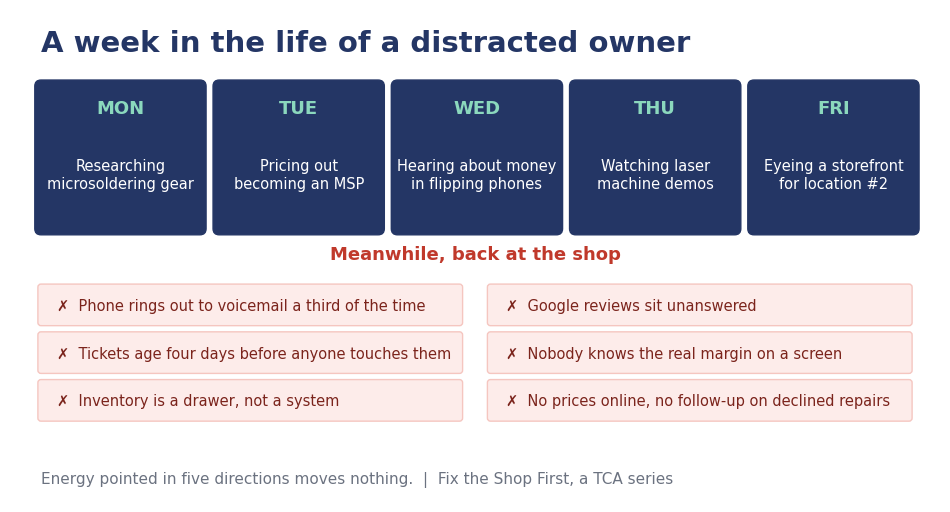
Graphic showing a repair shop owner researching microsoldering, MSP services, phone flipping, laser machines, and a second location Monday through Friday, while unanswered calls, aging tickets, unknown margins, and uncontrolled inventory pile up back at the shop

I’m not picking on this owner, whoever they are, wherever you are. I ran a thirteen-location chain back in the day, and I was this owner. And I’ll be the first to admit the game was easier then. The industry has changed, and today’s operators face far more competition than we ever did, from combo shops and kiosks to mobile operators, all fighting for the same customers. That’s an argument for more focus, not less. Repair shop owners are entrepreneurs, and entrepreneurs see opportunity everywhere. Accessories. Used devices. IT services. Data recovery. Recycling. B2B contracts. Mail-in. That instinct built this industry.

But every one of those opportunities consumes some combination of capital, inventory, training, marketing, management attention, floor space, and time. And the TCA’s own research this spring showed exactly where that attention should be going instead. Our May report on why repair shops are losing customers to replacement found that shops are bleeding business over the basics: unanswered calls, poor communication, pricing friction, and a buying experience that makes repair harder to choose than replacement.

Before asking what else you can sell, ask how much more repair business you could capture by getting better at the business you’re already in.

The game has changed: everyone has insurance now

Direct answer
The single most talked-about change in today’s repair world is device protection. One-third of US smartphone owners now purchase protection for their devices, according to consumer tracking firm Circana, and nearly all of those plans are sold through channels that route repairs to a handful of giant operators before an independent shop ever sees the device.

Where the protection plans get sold

Sit with that number. A third of the smartphones in your market may already have a repair path decided before they ever break. And look at where those protection plans get sold. Wireless carriers are the leading channel, bundling protection at the point of sale, with those policies serviced almost entirely by two massive operators. Big-box retail and e-commerce make up the next major slice, powered behind the scenes by the same few giants. Device makers hold a smaller share through their own branded care programs. Independent and direct-to-consumer channels? They control under five percent of the market.
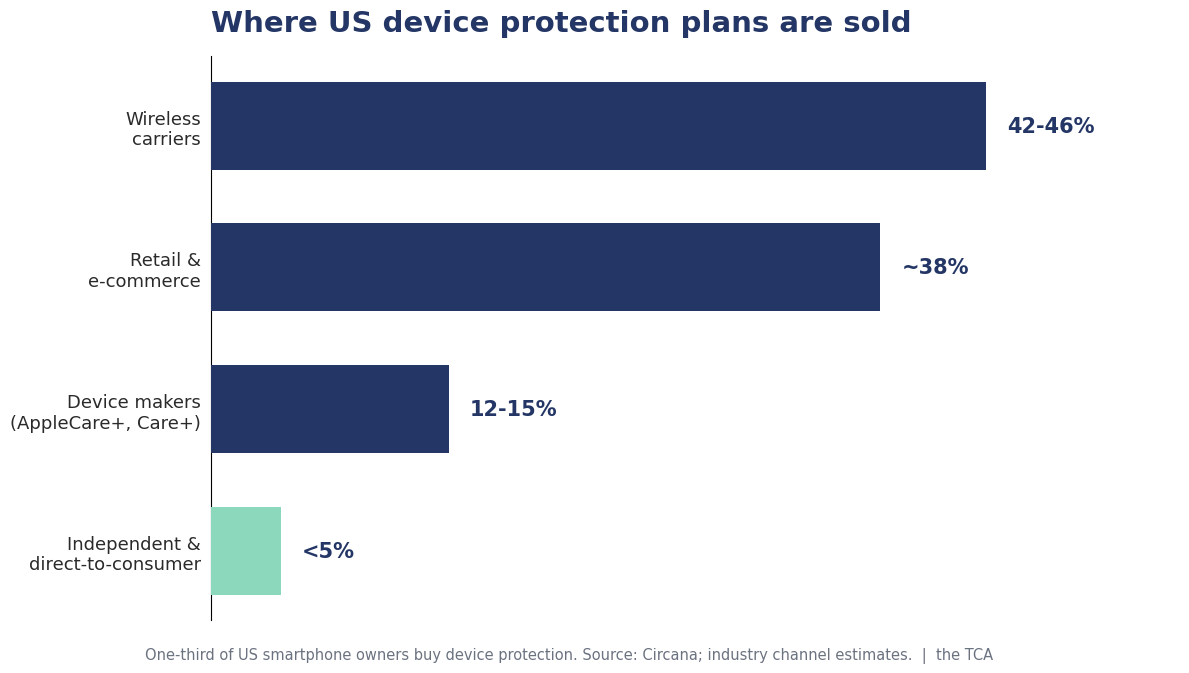
Bar chart showing where US device protection plans are sold: wireless carriers lead at roughly 44 percent, retailers and e-commerce near 38 percent, device manufacturers around 13 percent, and independent channels under 5 percent

If you read our Operators in Motion piece, this should sound familiar. The two biggest repair-network exits of the last era both landed inside insurance companies, because those companies need repair capability to deliver what they sell. The protection economy sits on top of our industry and pre-routes an enormous share of the work.

Here’s what that means for the thesis of this series. It does not mean run out and start selling protection plans; that’s the chasing reflex this series exists to interrupt, and you’d be walking into the most consolidated corner of the entire market. It means the customers who are still choosing their own repair shop, the majority who skip protection plus everyone whose plan disappoints them, choose on trust, speed, reviews, and experience. The shops that win them are the ones that fixed the shop first. That is how you grow a tech repair business in a market where a third of the customers are spoken for before the screen ever cracks.

Why a good idea and hard work are not enough

Here’s the uncomfortable truth behind those show-floor conversations. A good idea and hard work are the entry fee, not the win condition. Plenty of hard workers fail every year because nobody wants to buy what they built, or because the money ran out before the market showed up. To succeed, you also need at least four other things:

Market demand

People have to want to buy what you’re selling, in your market, at your price. And not every idea or product plays well in every market: what thrives in a college town can starve in a retiree suburb, and what works in a dense city can flop in a rural county. If the market is too small or simply doesn’t care, working harder will not fix it. This is where “the space is already crowded” and “somebody already tried this here and it died” should be treated as data, not as challenges to your pride.

Cash flow

You need money to pay the bills before the new thing turns a profit, and new ventures always take longer than the plan says. Running out of cash is the most common way a new business closes, and it’s how a healthy repair shop gets dragged down by its own side project.

Timing

Launching too early or too late can kill a genuinely great idea. Some of the failures in this industry weren’t bad ideas. They were right ideas at the wrong moment, and the person trying it again five years later without understanding why it failed the first time is set up to repeat the result.

Smart strategy and the right team

Working hard on the wrong tasks wastes the one resource you can’t buy more of. You need a clear plan, the right skills, and people besides yourself who can run the thing.

Part 2 of this series digs into each of these in detail. For now, hold onto the pattern: the graveyard of this industry is full of good ideas executed by hard workers who were missing one of those four ingredients.

What the research says about chasing adjacencies

This isn’t just my read from the show floor. The business research on how companies try to grow, and how often expansion backfires, is remarkably consistent, and remarkably grim.

Bain & Company studied nearly 300 adjacency moves by retailers, meaning expansions into products, services, and markets next to the core business. Only 29% produced profitable growth. Only 15% produced significant increases in both revenue and profit. The strongest predictor of success was how close the expansion stayed to the company’s existing customers, capabilities, and cost structure.

A related Bain study published in Harvard Business Review put it even more starkly: roughly three-quarters of attempts to grow into adjacent markets fail. And the companies that did succeed at adjacency expansion had one thing in common. They already had strong core businesses before they expanded.

Then there’s the complexity problem. Research summarized in Harvard Business Review found that most businesses offer more products and services than the profit-maximizing number. Every additional offering creates operational complexity, and the cost of that complexity quietly eats into margins long before anyone notices it on a spreadsheet.
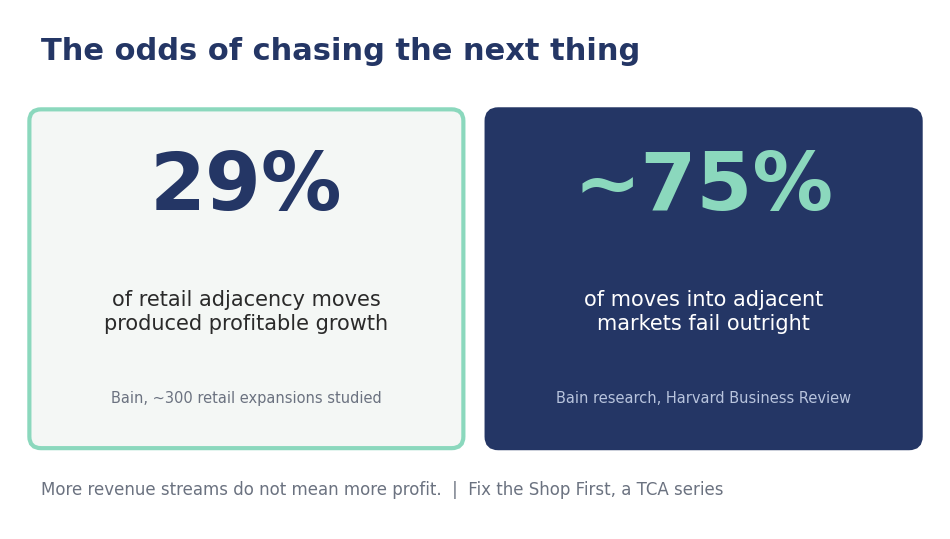
Stat graphic on why chasing adjacencies is a risky way to grow a tech repair business: only 29 percent of retail adjacency moves produced profitable growth and roughly 75 percent of adjacent market expansion attempts fail, per Bain research

Put those findings together and you get the sentence I want every shop owner to tape above the bench:

More revenue streams do not mean more profit.

A shop doing $700,000 of complicated, poorly managed business across six ventures is not healthier than a shop doing $500,000 of highly repeatable repair work at strong margins. The second owner sleeps better, banks more, and is in a far stronger position to grow a tech repair business later, on purpose, from strength.

Broaden your capability, don’t dilute your model

Now, if you’ve been reading the TCA blog for a while, you might be raising an eyebrow. Haven’t we spent the past year telling you the opposite?

We published Beyond Phone Repair, showing that your skills already transfer across ten consumer electronics categories. We published Operators in Motion, celebrating owners who grew from the bench into refurbishment, ITAD, resale, and software. We’ve covered data recovery as an expanding profit center. We stand behind every word of it.

This series is not a retraction. It’s the missing chapter.

Here’s the distinction that resolves it. A shop repairing phones, tablets, laptops, consoles, and wearables is still fundamentally running one repair business. Same skills, same workflow, same customer promise, wider funnel. That’s broadening your capability, and it’s usually smart.

A shop simultaneously trying to operate repair plus prepaid wireless plus used-device retail plus IT services plus eBay resale plus recycling plus insurance sales may be running seven mediocre businesses out of one storefront. That’s diluting your model, and it’s usually how good shops become tired shops.

Comparison graphic: one repair business covering phones, tablets, laptops, consoles, and wearables versus eight separate businesses crammed into one storefront, illustrating broadening capability versus diluting the business model

Ask the uncomfortable questions first

So before you bolt anything new onto the counter, ask yourself some uncomfortable questions. Do your customers actually want additional products and services from you, or do they want you to do more of the core repair work they already trust you with? If you sell them something they didn’t come for, can it hurt the business you already have? Do they want to deal with a salesperson or a repair person? And if you push sales too hard, does it damage the trust that drives your repair traffic in the first place? Every one of those answers decides whether you grow a tech repair business or merely complicate one.

My honest take, after two decades in this trade: people come to you for repair, and repair only. Layering sales on top of that relationship is much harder than it looks, and very few shops pull it off without eroding the thing that made customers walk in.

Every operator in motion we profiled earned the move first. Their pattern was never “chase everything.” It was master the core, systemize it, and then expand from strength into work that used the same customers, skills, and trust they’d already built. Expansion is a multiplier. Multiply a strong operation and you get growth. Multiply a broken operation and you get a bigger broken operation.

Expand only when the core has earned you the right to expand.

You can’t fix what you don’t measure

So how do you know whether your core has earned it? You measure it. Honestly, and from the outside. Nobody has ever managed to grow a tech repair business on numbers they didn’t know.

That’s exactly why the TCA built TCA ShopCheck, the free shop health check we launched at AWPE last month. In about two minutes, it scores your business across the five things that actually determine whether the core is strong: whether customers can find you, whether they choose you, whether you win the job, whether you run the operation well, and whether you’re set up to grow. It’s free, it stays free, and it exists because most owners have never had an objective look at their own shop.

Run it before you spend another hour researching that laser machine. If the score stings a little, good. That sting is the gap between the business you have and the business you could have without adding a single new venture.

And keep an eye on this space. TCA ShopCheck is the first tool in what we’re building into a full suite, with more advanced tools coming that go deeper into analyzing your operations, your numbers, and your readiness to expand. The shops that measure will always beat the shops that guess.

Find people who will pick your idea apart

One more thing before I lay out the series, because it came up in almost every one of those show-floor conversations.

The owners chasing crowded spaces and repeating past failures had something in common: everyone around them loved the idea. Their techs loved it. Their regulars loved it. Their Facebook group loved it. What they didn’t have was a single person with real authority and experience whose job was to pick the idea apart.

Your fans are great at identifying their problems and terrible at inventing your solutions. There’s a famous line, probably apocryphal, attributed to Henry Ford: if he’d asked people what they wanted, they’d have said faster horses. Customers ask for incremental versions of what already exists. Your loudest supporters don’t represent your average customer. And people will enthusiastically tell you they want something right up until you ask them to pay for it.

What you need is hard, honest feedback from people with the experience to know where the bodies are buried. People who will ask what the market demand actually is, what happened to the last three shops that tried it, and what your cash position looks like in month nine. That kind of feedback is uncomfortable, and it is worth more than a hundred likes. Part 5 of this series is entirely about where to find it and how to use it.

What’s coming in this series

Over the next several weeks, Fix the Shop First will build the complete argument, and the complete toolkit:

  1. Stop Chasing the Next Thing: Fix the Shop First (you’re reading it)
  2. The Industry With No Giants: why an industry this big has no dominant players, and what the churn rate is telling us
  3. A Good Idea and Hard Work Are Not Enough: the four ingredients that actually determine success
  4. Do You Actually Have a Profitable Repair Business?: the numbers every owner must know cold
  5. The Boring Stuff Is Where the Money Is (and Facebook Isn’t): the six figures hiding inside the shop you already own
  6. Your Fans Are Lying to You (Kindly): how to get feedback that actually protects you
  7. Everybody’s Right and Everybody’s Wrong: the silo problem, and how to vet the voices you follow
  8. When You Should Add Something New: the TCA Expansion Test
  9. Build Your Repair Machine: the TCA Core-First Growth Model

By the end, you’ll have a framework for knowing exactly when your shop has earned the right to expand, a plan for what to do until then, and a clear answer to the question every owner eventually asks: how do I grow a tech repair business without breaking the one I have?

Common questions about repair shop focus

Should a tech repair shop diversify into new revenue streams?

Only after the core repair business is consistently profitable, measured, and able to run without the owner touching everything. Research on business adjacency moves shows roughly three-quarters fail, and the successes almost always came from companies with strong core businesses first. Expansion multiplies whatever you already have, strong or broken.

Is repairing more types of devices the same as diversifying?

No. Adding tablets, laptops, consoles, and wearables to a phone repair shop broadens one repair business using the same skills, workflow, and customer trust. Diversifying means running fundamentally different businesses, like resale, IT services, recycling, and insurance, from the same storefront. The first widens your funnel. The second divides your attention.

How do I know if my repair shop is ready to grow a tech repair business beyond repair?

Start by measuring the core objectively. TCA ShopCheck is a free two-minute health check that scores your shop on getting found, getting chosen, winning the job, running well, and growing. If the core scores strong and you can answer the market demand, cash flow, timing, and team questions honestly, you’re ready to run the TCA Expansion Test coming later in this series.

Want to grow a tech repair business? The next thing can wait. The shop can’t.

If you walked one of those show floors with me this summer, you saw an industry full of energy, ideas, and ambition. That’s our strength. But energy pointed in six directions moves nothing. The owners who win over the next five years won’t be the ones with the most ideas. They’ll be the ones who built one great repair business first, measured it honestly, listened to people willing to tell them the truth, and then expanded from strength.

Next Tuesday, Part 2 asks the question hiding underneath all of this: why has an industry this large produced almost no giants? The answer lives in our brutal churn numbers, a century-old trade route working against us, and a focus problem nobody wants to name. If you’ve ever wondered why the revolving door of shops opening and closing never stops spinning, that post is for you.

Until then, run your shop through TCA ShopCheck. It takes two minutes, it’s free, and it might be the most honest conversation your business has had in years.

How healthy is your shop, really?

TCA ShopCheck is a free two-minute health check built for independent repair shops. No sales pitch, no strings. Just an honest score and a place to start.

Run TCA ShopCheck Free

More from the TCA Blog

Rob Link is the founder of the TCA. He built and ran a multi-location repair chain in an earlier era of this industry, and he’d tell you today’s operators have it harder. The TCA is independent of carriers, manufacturers, and insurance companies, which is exactly why it can tell shop owners the truth about growth.

Sources: Circana, smartphone protection purchase data (2025). Bain & Company, “Growing Beyond Your Core in Retail” (study of nearly 300 retail adjacency moves). Zook & Allen, “Growth Outside the Core,” Harvard Business Review. Gottfredson & Aspinall, “Innovation Versus Complexity: What Is Too Much of a Good Thing?”, Harvard Business Review. The TCA’s State of Tech Repair 2026 research. The Tech Care Association (TCA) is the leading nonprofit trade association for independent tech repair professionals in North America.

We went to Mobile Disrupt with a camera and a list of the most interesting people in the tech care ecosystem. We came home with 19 conversations about repair, reuse, and the fight against e-waste, and they are all coming to the TCA YouTube channel.

By Rob Link, Founder & CEO, Tech Care Association · August 3, 2026 · 7 min read

Key Takeaways

  • Second Life Sessions is a new TCA interview series: 19 one-on-one conversations filmed at Mobile Disrupt in Miami with people working across repair, reuse, reverse logistics, and responsible recycling.
  • The interviews were conducted by Emily Blethen, whose sustainability background connects the day-to-day work of repair back to the bigger environmental picture.
  • Every guest answered the same four questions, including the big one: what do you wish more people understood about the e-waste crisis?
  • Episodes land on the TCA YouTube channel in the coming weeks, with shorts and clips rolling out across our socials. Subscribe now so you don't miss the launch.

What's in this post

  1. The person behind the camera
  2. The questions we asked
  3. Meet the guests
  4. You're going to want to watch these
  5. Why we show up, and why you should too
  6. Help us tell their stories
  7. Common questions about Second Life Sessions

If you've followed the TCA for any length of time, you know one of my favorite things to do: promote the people in this industry who are doing great things. And here's the truth. We have so many people doing great things. Repair educators. Shop owners. Software builders. Parts suppliers. Recyclers. Reuse advocates. People quietly solving hard problems every single day, keeping devices in use and out of landfills.

Their stories deserve to be told. So we're telling them.

At Mobile Disrupt, while thousands of repair professionals, refurbishers, and industry partners were networking on the show floor, our team was pulling some of the most interesting people in the tech care ecosystem aside for one-on-one interviews. The result is Second Life Sessions, a new interview series from the TCA exploring repair, reuse, and the fight against e-waste, told through the voices of the people actually doing the work.

Second Life Sessions by the numbers: 19 guests, 17 organizations, 1 show floor. A new interview series from the Tech Care Association, filmed at Mobile Disrupt 2026 in Miami.

The Person Behind the Camera

The Second Life Sessions interviews were conducted by Emily Blethen, who recently completed her Master of the Environment, Renewable & Sustainable Energy degree at the University of Colorado Boulder. Emily has been working with the TCA this summer to help expand our reach and complete special projects for the association. This series is a perfect example of what that partnership makes possible. Her background in sustainability brought exactly the right lens to these conversations: every interview connects the day-to-day work of repair and reuse back to the bigger environmental picture.

The Questions We Asked

Every guest sat down with the same core questions.

The four questions asked of every Second Life Sessions guest: where their work fits in the electronics life cycle, what they are building, how their work creates access to technology, and what they wish more people understood about the e-waste crisis.

The answers surprised us, and we think they'll surprise you too. Here's just one example, from our conversation with Ansar Khan of RepairDesk, whose platform serves as the operating system for independent repair stores around the world. His team integrates directly with major parts suppliers so store inventory manages itself, gives their software free to university repair centers, and is setting up a nonprofit that trains people with disabilities for careers in repair. But when we asked what he wished more people understood about the e-waste crisis, his answer was disarmingly honest: that repair stores exist. Before joining the industry, he didn't realize he could walk down the street and get his phone fixed, or at least get a quote.

"I'm guilty of defaulting to 'let's buy a new phone,'" he admitted, "partly because the carriers make it so easy with their deals."

Think about that. Someone now working at the heart of the repair industry once didn't know repair was an option. If that awareness gap exists even among tech professionals, imagine how wide it is among everyday consumers. Closing that gap is exactly why Second Life Sessions exists.

Meet the Guests

Here's the full Second Life Sessions lineup: the people doing great things, and the corner of the electronics life cycle where each of them is doing it.

Many of the people on this list I am proud, and have the pleasure, to call longtime good friends. And some of the new people I met at Mobile Disrupt will be soon enough. That's the way this industry works.

  • Ansar Khan (RepairDesk): The point-of-sale platform powering independent repair stores worldwide, on automating inventory and opening doors into repair careers.
  • Brennan Zelener (WholeCell): Inventory software built for the used-device business, where tracking every phone is the difference between profit and chaos.
  • Austin Martin (iFixit Pro): The most recognized name in repair education, on why repair should be every student's superpower.
  • Steve Manning (FutureDial): Automating the processing of used mobile devices at scale. The machinery behind the second-life economy.
  • Eden Morrison (URT): The responsible recycling side of the story: what happens when a device truly reaches the end of the line.
  • Tony Sciarrotta (former Executive Director, Reverse Logistics Association): A global authority on the returns industry, on returns, recovery, and why what flows backward through the supply chain matters as much as what flows forward.
  • Shannon Fertitta (RIOS): The Executive Director of the Recycling Industry Operating Standard, on what responsible recycling really requires, and why certification matters for everyone downstream.
  • Jon Newman (PrologMobile): The data behind the second-life device market, bringing transparency to every used phone that changes hands.
  • Frank Pipolo (FutureDial): A second perspective from the device-processing world on where automation is taking the industry.
  • Eric Houdek (Phone LCD Parts): The parts supply chain that keeps every repair bench in business.
  • Joel Mansnerus (Fixably): Repair management software, and what thousands of repair workflows reveal about where the industry is heading.
  • Peter Evans (All Things Circular): The circular economy in practice. Designing waste out of the system entirely.
  • Sandy Zimmerman & Jodi Ortiz (VT Services): A joint conversation, and one of the most energetic sessions we recorded, on their corner of the tech care world.
  • Michael Leiberman (Aeris Protective Packaging): Eco-friendly, recyclable air-chamber packaging that gets devices where they're going in one piece. A second life starts with surviving the shipment.
  • Louis Garcia Fabucci (Cellphone MD): The origin story so many shop owners will recognize: from one repair bench to a thriving business.
  • Jordan Notenbaum (MobileSentrix): Inside one of the largest parts and tools suppliers in the industry. The ecosystem repair shops depend on every single week.
  • Alberto Delgadillo (Mannapov): On the global trade in used devices and what it takes to do it right.
  • Chris Hale (SmartphonesPLUS): The buyback business. Turning the phone in your drawer into value instead of waste.
  • Rich Bulger (All Things Circular): Closing the loop on circularity, and what it takes to make reuse the default rather than the exception.

Every one of these guests gets their own full episode. These are just the opening notes. The real stories are in the conversations.

Diagram showing where the Second Life Sessions guests fit across the electronics life cycle: repair and education, parts and tools, processing and data, reuse and resale, logistics and packaging, and recycling and circularity.

You're Going to Want to Watch These

Here's the exciting part: it all starts in the coming weeks. All Second Life Sessions interviews will be published on the TCA YouTube channel, and we'll be releasing shorts, clips, quote cards, and highlights across our social channels throughout the series. Keep an eye out for all of our content on these interviews everywhere you follow the TCA. Sneak peeks are already rolling out, the series trailer is right around the corner, and full episodes follow close behind.

Trust us, you're going to want to watch these:

  • Learn from people who've done it. Every guest has built something: a shop, a platform, a training program, a recycling operation. These are practical insights from practitioners, not theory.
  • See the whole life cycle. Most of us work in one slice of the electronics life cycle. These interviews connect the dots between repair, refurbishment, reuse, and responsible recycling.
  • Find your next partner or idea. More than one guest described projects, integrations, and community programs that could spark your next revenue stream or collaboration.
  • Get fluent in the e-waste conversation. When customers ask why repair matters, you'll have stories and perspectives to share, straight from the people leading the movement.

Subscribe to the channel now so you don't miss a single episode, and watch our social feeds over the coming weeks. The previews, the trailer, and the first interviews are all on their way.

Why We Show Up, and Why You Should Too

None of these conversations would have happened if we hadn't been in the room. That's the thing about industry events: the best outcomes are almost never on the agenda. They happen in hallways, at booths, and across a camera lens between sessions.

Earlier this year, we made the case that 2026 is the year to show up. In an era of digital disconnect, in-person connection is one of the most valuable investments a repair professional can make. Second Life Sessions is proof of concept. We showed up at Mobile Disrupt, and we came home with 19 conversations worth sharing with the entire industry.

And we're not slowing down. This week, the TCA will be at the ITAD Summit (August 4–5), where the IT asset disposition world gathers to talk data security, value recovery, and responsible end-of-life management. Then on August 18–19, we'll be at the All Wireless & Prepaid Expo, one of the biggest gatherings for the wireless, prepaid, and repair retail community.

If you're attending either event, come find us. We'd love to meet you. And if you're still deciding which events deserve your time this year, the TCA Industry Events Calendar is the industry's only complete, independent, no-kickbacks list of tech repair, reuse, and tech care events. It's the best place to keep up to date on everything happening in this industry, all year long.

Help Us Tell Their Stories

This industry is full of people doing great things. Far more than one series can capture. Second Life Sessions is 19 stories. There are thousands more out there, waiting to be told.

The TCA is a nonprofit, and everything we produce, from this series to our free resources and the events calendar, is funded by the members who believe this industry deserves to be seen and heard. With more support from the industry, by joining the TCA, we can produce more content like this, so that more people can learn about what we do: how repair works, why reuse matters, and who the people behind it all really are.

So here's what you can do today:

  1. Subscribe to the TCA YouTube channel and turn on notifications for the series launch.
  2. Follow us on social for shorts and clips from the interviews over the next few months.
  3. Join the TCA and help us tell the stories of the people doing great things in this industry.

We can't wait to share them with you.

Common Questions About Second Life Sessions

What is Second Life Sessions?

Second Life Sessions is a video interview series from the Tech Care Association (the TCA) featuring 19 conversations with leaders in tech repair, reuse, and electronics recycling, filmed at Mobile Disrupt in Miami.

Where can I watch Second Life Sessions?

All Second Life Sessions episodes will be published on the TCA YouTube channel, with shorts and clips shared across the TCA's social media channels. Subscribe to the channel and turn on notifications to catch the series launch.

Who is featured in Second Life Sessions?

The series features Ansar Khan (RepairDesk), Brennan Zelener (WholeCell), Austin Martin (iFixit Pro), Steve Manning (FutureDial), Eden Morrison (URT), Tony Sciarrotta (former Executive Director, Reverse Logistics Association), Shannon Fertitta (RIOS), Jon Newman (PrologMobile), Frank Pipolo (FutureDial), Eric Houdek (Phone LCD Parts), Joel Mansnerus (Fixably), Peter Evans (All Things Circular), Sandy Zimmerman and Jodi Ortiz (VT Services), Michael Leiberman (Aeris Protective Packaging), Louis Garcia Fabucci (Cellphone MD), Jordan Notenbaum (MobileSentrix), Alberto Delgadillo (Mannapov), Chris Hale (SmartphonesPLUS), and Rich Bulger (All Things Circular).

Build your future with the TCA

Industry interviews, creator collaborations, market data, events, and advocacy built specifically for independent tech repair professionals. Membership starts free.

Join the TCA Community

More from the TCA Blog

Rob Link is the founder of the TCA. The TCA is independent of carriers, manufacturers, and insurance companies, which is exactly why it can tell the whole channel the truth about where this industry is headed.

Sources: Interviews recorded at Mobile Disrupt, Miami, July 7 and 8, 2026. Guest roles and affiliations confirmed against interview footage and public records. The Tech Care Association (TCA) is the leading nonprofit trade association for independent tech repair professionals in North America.

Slow season is training season. We went through 30 days of posts from the creators the TCA tracks daily and pulled the eight channels earning your bench hours right now, plus the live selling trend we watched happen in real time at Mobile Disrupt in Miami.

By Rob Link, Founder & CEO, Tech Care Association · July 13, 2026 · 8 min read

Key Takeaways

  • The TCA tracks dozens of tech repair content creators every day. Eight of them posted standout material in the last 30 days, from board-level saves to shop marketing masterclasses.
  • Live selling was everywhere at Mobile Disrupt in Miami. eBay Live and Whatnot were streaming and selling from the show floor, and the sellers we met say it is making them real money.
  • Repair professionals have a built-in edge in live selling: you can test, grade, and answer technical questions on camera in a way a drop-shipper never could.
  • The full creator list lives on the TCA's Tech Repair Content Creators resource page, and we want your recommendations for who to add next.

Summer is the slow season on a lot of benches. Fewer walk-ins, longer afternoons, and a choice: scroll or sharpen.

Here is the thing about slow season. The shops that come out of it stronger are the ones that treat it like training camp. New device families are landing this fall. Component prices are shifting under everyone's feet. And the skills gap between a parts-swapper and a board-level tech has never been worth more money.

At the TCA we track dozens of tech repair content creators every single day. Tutorials, teardowns, board repair walkthroughs, shop marketing, all of it. The full list lives on our Tech Repair Content Creators resource page, and it keeps growing.

We went through the last 30 days of posts across the channels we follow. Here are eight creators who published genuinely useful material, and why each one is worth your summer hours.

The eight creators worth your summer hours

1. iPad Rehab Microsoldering (Jessa Jones)

An iPhone 16 Pro Max came in with no display after a thunderstorm. Apple said motherboard replacement. Jessa found the actual fault and fixed it at board level.

This is the independent repair story in one video: what looks like a dead board to a parts-swapper is a repairable fault to a trained tech. Watch it for the diagnostic process. Then show it to the next customer who thinks "Apple said no" is the end of the road. It isn't.

2. VCC Board Repairs (Jesse Cruz)

Jesse thinks he has found the iPhone 16 Pro's next common failure, and he shows the fix.

This is the kind of intel that separates shops that react from shops that are ready. Common failures follow a predictable arc: early adopters hit them first, then the wave builds as devices age into year two. Those phones are coming to your counter either way. Better to recognize the fault pattern on day one and quote the job with confidence.

3. REWA Technology

REWA ran a skills clinic this month without calling it one. Microscope setup tips, hot air gun practice using nothing but a sheet of paper, a BMS swap that clears the unknown battery pop-up, and a straight-talk explainer on diagnostic-compatible iPhone parts.

Short videos, real technique, no fluff. The paper trick alone is worth passing to anyone on your bench who is still building hot air confidence. Cheap practice beats expensive mistakes.

4. Electronics Repair School

Sorin posts board repair the way it actually happens: dead laptops, weird faults, honest post-mortems. This month included a charging port replacement done fast and safe, a Lenovo repair where the customer had already swapped the chip and the board was still dead, and a budget tools review straight off TEMU.

He even helped another computer business diagnose a board on camera. That is the spirit of this industry at its best. Watch a few of his post-mortems and you will start catching faults faster on your own bench.

5. Parts-People

The Dell specialists run live motherboard repair streams nearly every week. It is free, recurring, watch-over-the-shoulder training for anyone leveling up on laptop board work.

Between streams they post rapid-fire diagnostic shorts on power rail shorts, no-POST boards, and GPU detection failures. Put the streams on a shop TV during slow hours. It beats the news, and somebody on your team will pick something up every single time.

6. Salem Techsperts

Not every valuable video teaches a repair. Salem Techsperts posted "The Used Laptop Market is Broken: NVMe Prices Officially Killed My Business" and it is required viewing.

Component pricing is squeezing refurb margins across the industry, and hearing a working shop owner walk through his numbers is worth more than any market report. If used device sales are part of your revenue mix, watch this one twice and then look hard at your own margins.

7. MONEY TALKS WIRELESS

Twenty-eight customer-story shorts in thirty days. The repairs are routine. The marketing is not.

Every video turns an ordinary ticket into a story people actually watch: the iPhone Apple said was unfixable, the memories recovered from a 15-year-old iPhone, the kid whose console got saved. No fancy production. Just a phone camera, a real customer, and a payoff.

Google banned tech repair ads back in 2018, and that door never reopened. Short-form video is one of the few marketing channels where a small shop can still outwork the big guys. If you want to see how it is done, study this channel.

8. E-z Fix (Martin Organista)

Thirty-two posts this month, most in Spanish: iPhone board repairs, storage upgrades, and a running Q&A series answering the questions customers actually ask, like Apple service versus your local shop and whether an old phone is worth fixing.

If your shop serves Spanish-speaking customers, this is both a training channel and a masterclass in customer education content. And if you have bilingual techs, Martin is proof there is a large, underserved audience waiting for repair content in their own language.

Pick two creators. Give them your slow afternoons this summer. Your fall self will thank you.

The trend we saw everywhere at Mobile Disrupt: live selling

We just got back from Mobile Disrupt in Miami, and one thing was impossible to miss. Live selling was not just a topic on stage. It was happening on the show floor, in real time.

Two hosts live streaming at the eBay Live booth at Mobile Disrupt 2026, holding up smartphones on camera with stacks of boxed devices on the table
eBay Live was streaming from the show floor at Mobile Disrupt, selling devices live during the event.

eBay Live had hosts on camera moving phones and AirPods while attendees walked past. Whatnot, which bills itself as a leader in live shopping, ran streams from its booth. And TikTok Shop kept coming up in nearly every conversation about where device resale is heading.

Whatnot booth at Mobile Disrupt 2026 with a seller live streaming laptop sales in front of a bright yellow Leaders in Live Shopping backdrop
Whatnot's booth ran live shopping streams right from the conference.

We talked to some of the companies behind this trend, and they came with receipts. The sellers making this work shared real numbers, and the short version is this: live selling is moving devices and making money for the shops and resellers doing it right now.

Here is why this matters for repair professionals specifically. Your bench skills already give you an advantage. You can test devices on camera, grade them honestly, and answer technical questions live in a way a drop-shipper never could. Trust sells, and nobody has more device credibility than the person who can open one up.

There is a lot more to unpack: which platform fits which business, what the fee structures look like, and what the sellers we met would do differently starting today. We will cover all of it in future articles and in our weekly Tech Repair Tidbits newsletter. Subscribe here so you do not miss it.

Who did we miss?

Our creator list is built by this community, for this community. If there is a repair creator you learn from, a channel your techs watch on lunch break, or a voice in another language we should be tracking, we want to know.

Drop a comment below or send us your recommendations and we will check them out for the Tech Repair Content Creators resource page. The best list in the industry only stays that way if the industry keeps building it.

And one more channel for your subscriptions

The TCA has a YouTube channel too, and it is about to get busy.

We recorded some great interviews at Mobile Disrupt in Miami: operators, platform builders, and people shaping where this industry goes next. We will be posting them to our channel soon, with clips rolling out on our socials. STAY TUNED.

The TCA recording an interview at Mobile Disrupt 2026 in Miami
One of the interviews we recorded at Mobile Disrupt, coming soon to the TCA YouTube channel.

Subscribe to the TCA on YouTube so the interviews land in your feed the moment they drop.

These 8 are just the start

The eight creators above are a fraction of the 40-plus channels we track on our Tech Repair Content Creators resource page. Repair tutorials, business coaching, sustainability voices, and long-form podcasts, all in one place, all vetted for repair professionals.

Bookmark the page. Pick two creators. Give them your slow afternoons this summer. Your fall self will thank you.

Common questions about repair creators and live selling

What are the best YouTube channels for tech repair professionals?

It depends on what you want to build. For board-level skills, iPad Rehab, VCC Board Repairs, REWA Technology, Electronics Repair School, and Parts-People all published strong material in the last 30 days. For shop marketing, MONEY TALKS WIRELESS is a live case study in short-form video. For Spanish-language repair content, E-z Fix leads the pack. The TCA maintains a full vetted list of 40-plus channels on its Tech Repair Content Creators resource page.

What is live selling and does it work for repair shops?

Live selling is selling devices and accessories through live video streams on platforms like eBay Live, Whatnot, and TikTok Shop, where viewers buy in real time. At Mobile Disrupt 2026, platforms were live selling directly from the show floor, and sellers reported it is generating real revenue. Repair shops have a natural advantage: they can test, grade, and answer technical questions on camera, which builds the trust that drives live sales.

How do I suggest a creator for the TCA content creators list?

Leave a comment on this post or contact the TCA through the contact page on techcareassociation.org. Share the channel name and what makes it valuable for repair professionals, and the TCA will review it for the Tech Repair Content Creators resource page.

Build your future with the TCA

Creator collaborations, cross-promotions, training events, market data, and advocacy built specifically for independent tech repair professionals. Membership starts free.

Join the TCA Community

Rob Link is the founder of the TCA. The TCA is independent of carriers, manufacturers, and insurance companies, which is exactly why it can tell the whole channel the truth about where this industry is headed.

Sources: Creator posting activity compiled from the TCA's daily channel tracking, June 11 to July 12, 2026. Live selling observations from Mobile Disrupt, Miami, July 7 and 8, 2026. The Tech Care Association (TCA) is the leading nonprofit trade association for independent tech repair professionals in North America.